Minnesota Farmland Market Shows Steady Strength as 2026 Sales Add New Clarity

accountJennifer Moran | calendar-monthJuly 29, 2026

The latest Farm Progress report reinforces what Land Sales Bulletin continues to see across Minnesota: even after two years of breakeven agriculture, farmland values remain steady and supported by excellent crop ratings, timely rains, and long‑term buyer confidence. Timely rains are helping farmers “out‑bushel” lower commodity prices and maintain yield potential.

While commodity prices have softened, the Farm Progress analysis points to multiple factors keeping land values firm: low sale volume, neighborhood competitive dynamics, government support, legacy equity, new investment money, 1031 exchange activity, interest rates, and inflation hedging . As Farm Progress notes, short‑term market weakness has not overtaken long‑term thinking in farmland decisions.

Key Minnesota takeaways:

  • Strong crop outlook with USDA rating corn 67% excellent and soybeans 65% excellent
  • Timely rains strengthening yield potential
  • Seller‑friendly conditions for A‑quality land despite breakeven economics
  • Multiple market forces supporting values beyond commodity prices
  • Competitive sales across Minnesota counties:
    • Blue Earth County: ~90 acres at $12,389 per acre, CPI 81.7
    • Faribault County: ~40 acres at $12,000 per acre, CPI 91.9
    • Le Sueur County: ~144.38 acres at $12,851 per acre, CPI 90.2
    • Murray County: ~160 acres at $10,100 per acre, CPI 92.8
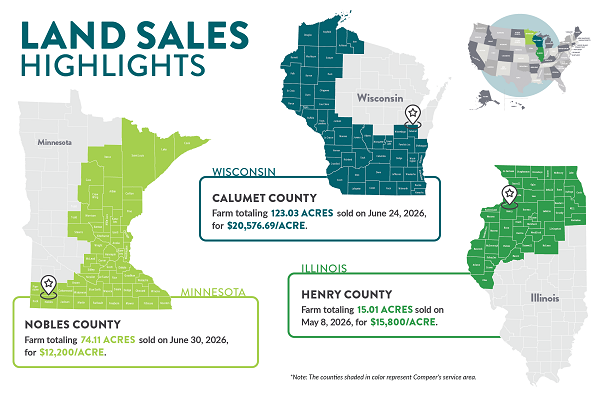
    • Nobles County: ~160 acres at $12,500 per acre, CPI 93.3
    • Polk County: ~80 acres at $10,000 per acre, CPI 91.1
    • Sibley County: ~120 acres at $11,000 per acre, CPI 91.8
    • Traverse County: ~141.21 acres at $8,500 per acre, CPI 93.7

As fall approaches, these finalized sales will provide additional data points that help define Minnesota’s market direction and reinforce the long‑term stability that continues to characterize the region. Read more from Farm Progress: Farmland market affected by much more than just commodity prices

Minnesota land sales - Farm Progress

Landwatch Weekly: Recent Midwest Farmland Sales Across Iowa, Indiana & South Dakota

accountJennifer Moran | calendar-monthJuly 24, 2026

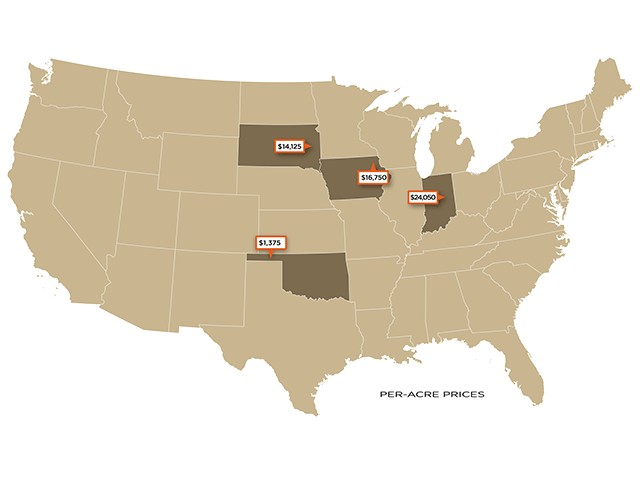
Progressive Farmer’s Landwatch Weekly column continues to show steady strength across Land Sales Bulletin’s Midwest reporting region. This week’s updates highlight positive momentum in Iowa, Indiana, and South Dakota, with strong per‑acre values and diversified land use driving buyer interest.

Midwest Highlights

  • Indiana – Wells County A 79‑acre farm sold for $24,050 per acre, supported by 52 acres of tillable ground and two residential homes.
  • Iowa – Allamakee County A 258‑acre multi‑tract sale averaged $16,750 per acre, with one premium tract reaching $27,400 per acre. Buyers were drawn to a mix of timber, tillable acres, recreational land, and Mississippi River views.
  • South Dakota – Brookings County A 40‑acre farm sold for $14,125 per acre, featuring strong cropland SPI (81.9), livestock paddocks, a residence, and a heated shop — a well‑rounded operational property.

These finalized sales reinforce continued confidence in high‑quality cropland, diversified land assets, and properties with strong residential or operational improvements across the Midwest.

Source: Progressive Farmer — Landwatch Weekly
Article Link: https://www.dtnpf.com/agriculture/web/ag/news/business-inputs/article/2026/07/23/recent-farmland-sales-indiana-iowa

Midyear 2026 Farmland Values: Resilience Across Land Sales Bulletin’s Midwest Reporting States

accountJennifer Moran | calendar-monthJuly 22, 2026

Benchmark farmland values across Iowa, Nebraska, South Dakota, and Wyoming remain flat to slightly higher in mid‑2026, according to Farm Credit Services of America’s July Benchmark Farmland Report. Values are supported by strong buyer financials and an already tight real estate market that saw even fewer sales in the first half of the year.

Iowa cropland dipped modestly, leaving overall benchmark values flat. Nebraska, South Dakota, and Wyoming posted incremental gains across both cropland and pasture since January.

The report also highlights broader trends across grain and protein‑producing states served by collaborating Farm Credit associations, reinforcing long‑term appreciation and durable demand across the Midwest.

Iowa*

  • 6‑month change: 0.0% | 1‑year change: ‑1.4%
  • 5‑year change: 31.6% | 10‑year change: 51.1%

Nebraska*

  • 6‑month change: +1.2% | 1‑year change: +3.2%
  • 5‑year change: 42.9% | 10‑year change: 39.2%

South Dakota*

  • 6‑month change: +4.2% | 1‑year change: +6.4%
  • 5‑year change: 71.6% | 10‑year change: 61.8%

Wyoming

  • 6‑month change: +2.7% | 1‑year change: +6.0%
  • 5‑year change: 55.4% | 10‑year change: 99.6%

Market Context

  • Tight real estate supply and financially strong buyers continue to support values region‑wide
  • Benchmark values across all four states show significant long‑term appreciation, with ten‑year gains averaging nearly 100%

*Land Sales Bulletin’s Midwest Reporting States

Full Report: Farmland Values 2026: Trends in Iowa, Nebraska, South Dakota and Wyoming | FCSAmerica

Midwest Farmland Values: Strong Sales Across IL, MN, MO, and SD

accountJennifer Moran | calendar-monthJuly 16, 2026

Farmland sales across our reporting states of Illinois, Minnesota, South Dakota, and neighboring Missouri continue to show the Midwest’s steady land market strength. Progressive Farmer’s latest report highlights multi‑tract auctions with strong per‑acre prices, solid soil ratings, and diversified tracts that reinforce ongoing buyer demand across the region.

  • Illinois (Livingston County): A 236‑acre farm sold for $2.7M, averaging $11,350/acre.
  • Minnesota (Cottonwood & Watonwan Counties): A 449‑acre auction brought $5.2M — averaging $11,775/acre — with soil ratings in the 90s.
  • South Dakota (Moody County): A 407‑acre farm sold for $5.3M at $13,100/acre.
  • Missouri (Sullivan County): A 164‑acre farm sold for $1M, with cropland tracts averaging $4,750/acre and mixed-use features including pasture, hayfields, timber, and a home site.

Progressive Farmer’s coverage underscores the strength of Midwest farmland values and provides timely insights for producers, investors, and land professionals across our Land Sales Bulletin reporting states, and Missouri. https://www.dtnpf.com/agriculture/web/ag/news/business-inputs/article/2026/07/16/recent-farmland-sales-illinois-south

Summer 2026 Farmland Values: Stability Across Illinois, Iowa, Minnesota & Nebraska

accountJennifer Moran | calendar-monthJuly 1, 2026

Farmland values across Land Sales Bulletin’s Midwest reporting region continue to show steady, resilient performance heading into Summer 2026, according to Hertz Farm Management’s latest update.

  • Iowa remains stable, with farmland values increasing 1.3% from September 2025 to March 2026 . Over the past 12 months, Iowa posted a net 0.3% gain after a brief dip earlier in 2025.
  • Illinois shows a choppy‑sideways trend. “Excellent” quality land declined 3%, while “Good” and “Average” land remained flat and “Fair” land increased 2% . Despite near‑term caution—61% of respondents expect prices to decline in 2026 —values remain 49–54% above 2020 levels.
  • Nebraska cropland values softened, declining 1–3% statewide, while grazing land rose up to 7% on strong cattle prices . Overall agricultural land values fell 1% year‑over‑year, marking a second consecutive annual decline.
  • Minnesota remains resilient, with modest increases in non‑irrigated cropland prices and ranchland rents, while irrigated rents declined . Lenders remain cautious, with 64% expecting farm incomes to decrease in the year ahead.

Across the Corn Belt, limited land supply, steady buyer interest, and stable long‑term fundamentals continue to support values despite tighter margins and broader economic volatility. Read more from Hertz Farm Management: https://www.hertz.ag/blog/detail/farmland-values-update-summer-2026

Iowa Farmland Values Hold Steady as Key Market Factors Take Shape

accountJennifer Moran | calendar-monthJune 16, 2026

In a new analysis from Doug Hensley, President of Hertz Real Estate Services, Iowa enters the 2026 growing season on “stable legs” thanks to limited land supply and continued buyer demand. Hensley outlines three forces that will shape the direction of Iowa’s land market through the second half of the year: crop prospects, geopolitics, and interest rates.

Iowa farmers — who continue to purchase 70% to 75% of row‑crop farms offered to the market — remain closely tied to in‑season yield expectations, influencing how aggressive they are in bidding for land. Geopolitical variables, including China’s soybean demand and the economic ripple effects of the Iran conflict, add further uncertainty for commodity prices and farm‑level profitability. Meanwhile, interest rate direction remains a critical watchpoint as inflation pressures push borrowing costs higher.

Despite these moving parts, recent Iowa sales — from Sioux County’s $26,600/acre auction to strong CSR2‑adjusted prices across counties like Story, Cedar, and Marion — reinforce the market’s underlying stability. Farm Progress: Will stable Iowa land values continue? Watch these 3 factors

As one of Land Sales Bulletin’s Midwest reporting states, Iowa continues to demonstrate resilience, disciplined demand, and a market that rewards high‑quality farmland even in a complex economic environment.

South Dakota Farmland Market Update: Stability Driven by Local Demand

accountJennifer Moran | calendar-monthJune 12, 2026

South Dakota continues to demonstrate steady strength and stability in the Midwest farmland market, supported by limited supply, strong operator interest, and stable cash rents. As one of Land Sales Bulletin’s Midwest reporting states, South Dakota remains a key region where finalized sales data helps producers, lenders, and landowners understand real-time market conditions.

Recent insights from ASFMRA‘s South Dakota Ag Update highlight several consistent themes. High-quality tracts continue to draw competitive bidding, with local producers leading most purchases. Investor activity remains present but secondary to operator demand. Cash rents are holding firm across much of the state, supported by strong balance sheets and the ongoing scarcity of acres coming to market.

With planting season progressing and producers optimistic about field conditions, the overall outlook remains steady. Limited supply continues to be the defining factor supporting values, even as margins tighten and operating costs rise.

Tune in to learn more in ASFMRAs South Dakota Ag Update.

Land Sales Bulletin will continue to track finalized sales across South Dakota and the broader Midwest to keep the market informed.

Illinois Farmland Sales Hold Steady in Q1 as Smaller Tracts Lead the Way

accountJennifer Moran | calendar-monthJune 1, 2026

Illinois farmland sales remained steady through the first quarter of 2026, with more than 10,190 acres changing hands and total reported sales topping $103.5 million. Most transactions clustered between $10,000 and $13,000 per acre, reflecting a balanced, stable market despite broader economic pressures.

One of the most notable trends was the continued strength of smaller tracts under 80 acres, which averaged $11,443 per acre, outpacing larger farms by roughly $640 per acre. Local farmers remained the dominant buyers, accounting for 57% of purchases statewide.

Top-end parcels continued to command premiums, with several sales exceeding $20,000 per acre in counties such as Hancock, Effingham, and Christian. While market signals point to ongoing volatility, Illinois farmland values overall remain supported by strong local demand and consistent pricing. Successful Farming: Illinois Farmland Sales Top $103 Million in Q1 as Small Tracts Outpace Larger Farms

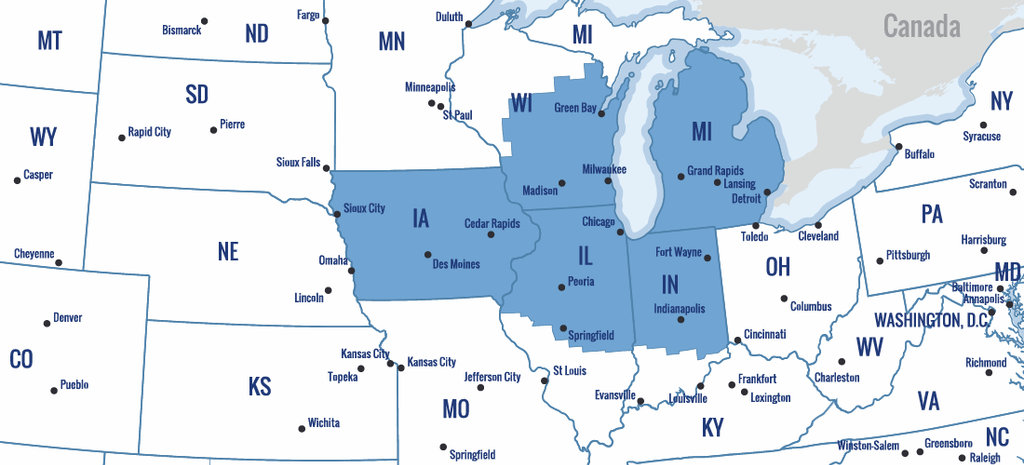
As always, Land Sales Bulletin, reporting finalized land sales across its 10‑state Midwest region—including Illinois—continues to track these trends to keep buyers, sellers, and advisors informed.