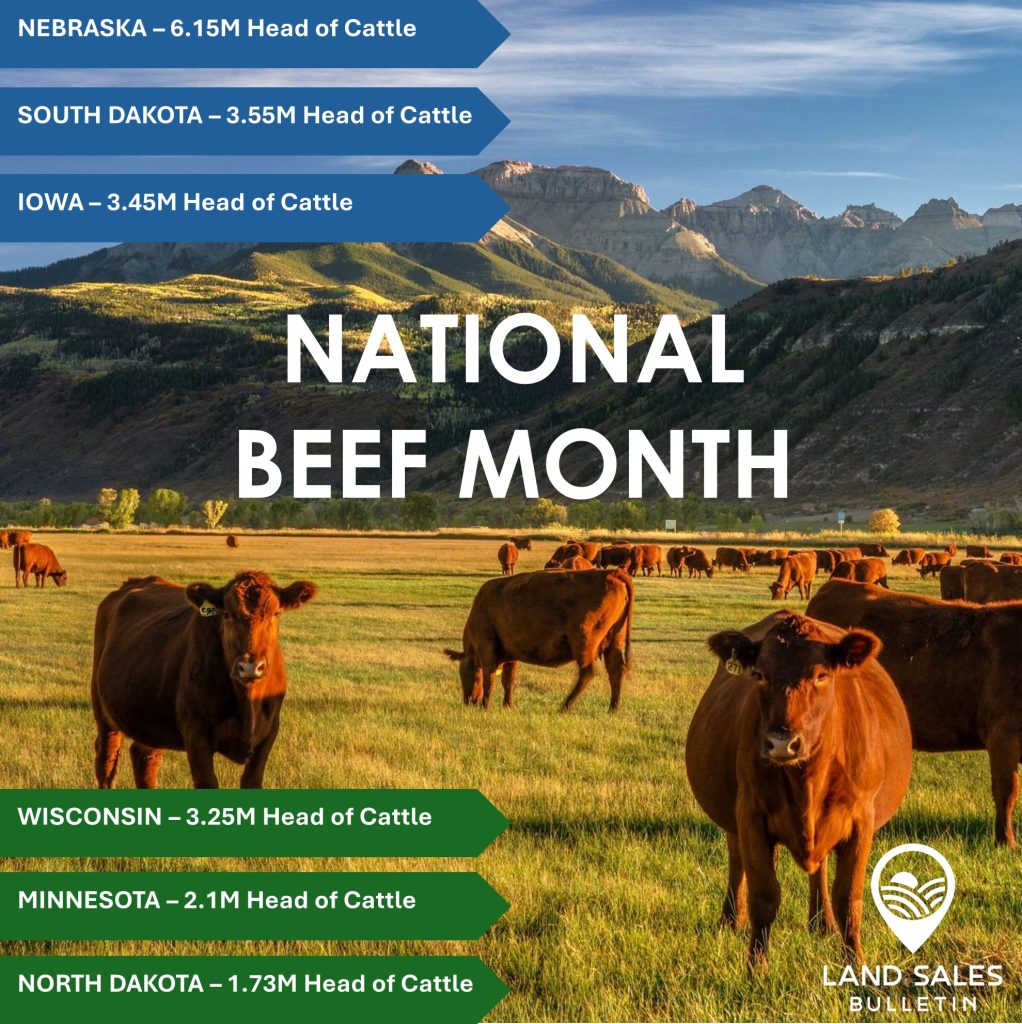
May is National Beef Month and we’re celebrating our top ranked Midwest states: Nebraska, South Dakota, Iowa, Wisconsin, Minnesota, and North Dakota!
Join us in showing appreciation for the cattle ranchers who rise early each day to rustle up their herds and provide food for the world; the U.S. beef industry is still the largest in the world! See a complete list of all U.S. states:May is National Beef Month and we’re celebrating our top ranked Midwest states: Nebraska, South Dakota, Iowa, Wisconsin, Minnesota, and North Dakota!
Join us in showing appreciation for the cattle ranchers who rise early each day to rustle up their herds and provide food for the world; the U.S. beef industry is still the largest in the world! See a complete list of all U.S. states: U.S. Head of Cattle – January 1 2025 and 2026
A recent Louisa County auction underscored the continued strength of Iowa’s farmland market, with a 79‑acre tract selling for $21,050 per acre—well above the county’s average value of $11,632 per acre. The multi‑tract sale drew 46 registered bidders from at least 12 states, reflecting broad demand for high‑quality row‑crop ground paired with recreational timber.
The top‑selling tract featured a strong CSR2 of 88.4, appealing to both local and out‑of‑state buyers. Additional timber tracts, including parcels adjacent to the Cairo Woods Wildlife Area, also attracted competitive bidding.
As one of Land Sales Bulletin’s 10 Midwest reporting states, Iowa continues to demonstrate resilient buyer interest, with premium soils and recreational attributes driving strong results across the region. Read more from Successful Farming: Southeast Iowa Farmland Sells for $21,050 Per Acre, Draws Multi-State Bidding
Illinois farmland sales remained strong in March 2026, with more than 4,100 acres changing hands and total transactions exceeding $40.4 million. Activity spanned key agricultural counties including Grundy, Hancock, and McLean, where high-quality Class A tracts continued to draw competitive bidding from both local operators and investors.
Notable sales included two 120.52‑acre tracts in Grundy County that sold for $16,900 per acre, reflecting strong demand for highly productive soils with PI ratings above county averages. In Hancock County, a 138.69‑acre tract sold for $7,775 per acre, supported by strong organic matter and fertility advantages. McLean County saw 72.55 acres sell for $15,600 per acre, backed by strong yield history and solid soil productivity.
Market analysts note that despite higher interest rates and elevated input costs, Illinois farmland values remain resilient. Limited supply, strong balance sheets, and steady investor interest continue to support pricing across the state—one of Land Sales Bulletin’s 10 Midwest reporting states. Read more from Successful Farming: Illinois Farmland Auctions Bring Over $40 Million in March
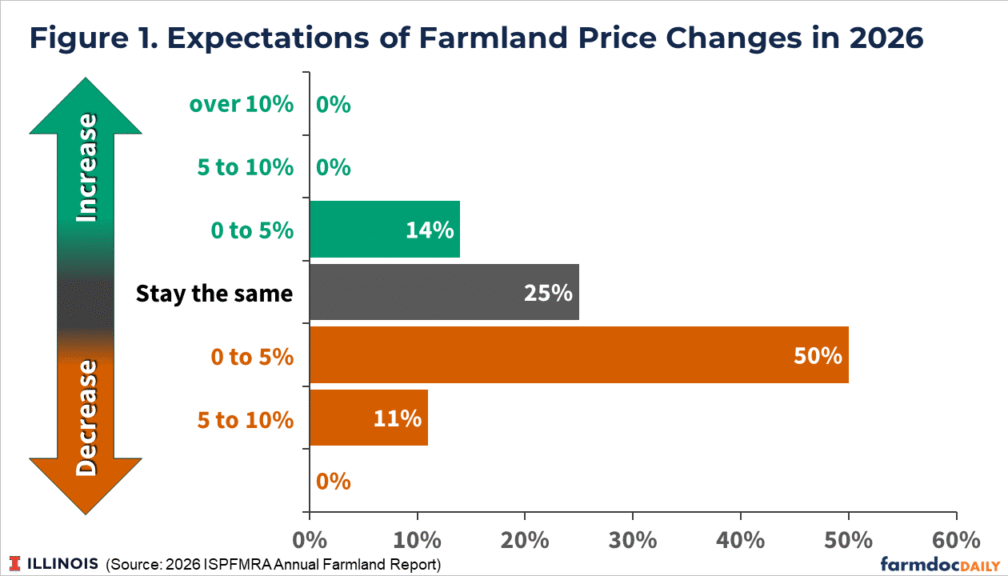
Illinois farm managers expect farmland values to soften slightly in 2026, with most anticipating a 1%–5% decline and some projecting up to 10%. According to the Illinois Society of Professional Farm Managers and Rural Appraisers, excellent farmland averaged $15,846 per acre in 2025, down 3% from the prior year, while good‑quality land held steady. Recreational land, however, saw an 11% increase.
Shifts in cash rent expectations, tighter farmer liquidity, and broader economic pressures—including fertilizer costs and global conflict—are shaping the outlook. As Illinois remains a core state within Land Sales Bulletin’s 10‑state Midwest reporting region, readers can track verified sales and market trends across the region with consistent, county‑level detail.
Nebraska remains a key state within Land Sales Bulletin’s 10‑state Midwest reporting region, and the latest preliminary data from the 2026 University of Nebraska Farm Real Estate Market Survey reflects a market adjusting to tighter margins and shifting sector strength.
Statewide farmland values dipped 1% to $3,905 per acre, marking the second consecutive year of decline as crop producers face narrower margins and softer receipts. In contrast, grazing and hay land values rose 4% to 7%, supported by strong cattle prices and historically low cow herd numbers.
Regional differences remain notable:
East District continues to lead at $9,315/acre (down 1%).
North Region saw the strongest gains, up 4%.
Southeast District posted the largest decline at –3%.
Cash rents followed similar patterns, with cropland rents slipping 1% to 9% depending on land type, while pasture rents strengthened.
As one of Land Sales Bulletin’s core Midwest reporting states, Nebraska’s evolving land values, rental trends, and sector‑specific pressures continue to shape the broader regional story. The final UNL report, expected in June, will add detail on land grades, transaction characteristics, and auction trends. Read more from Farm Progress: Average Nebraska farmland values drop for second straight year
A major North Dakota land auction—spanning 4,398 acres across four counties, brought in $21.82 million, landing nearly even with its two‑year‑old appraisal. The results highlight what we’re seeing across the region: buyers remain active, but they’re more selective than in past peak years. Some tracts soared above 120% of appraisal values, while others settled lower, reflecting a market that rewards high‑quality soils, strong access, and proven productivity.
As one of Land Sales Bulletin’s Midwest reporting states, North Dakota continues to demonstrate that while the market isn’t at the highs of 2022, it remains far from collapsing. Demand is steady, capital is active, and buyers are selective, reflecting a more mature, disciplined phase of the land cycle. Farm Progress:North Dakota auction shows a disciplined but still strong land market
Iowa farmland auctions brought in more than $78 million in March, with over 10,600 acres changing hands across the state. Sales in counties such as Louisa, Sioux, and Ringgold reflected strong demand for high‑quality cropland and well‑maintained pasture, even as broader market conditions remain steady and increasingly selective.
Economists note that Iowa’s land values continue to be supported by limited supply, consistent buyer interest, and stronger livestock margins, while crop producers face tighter profitability. These dynamics mirror trends across Land Sales Bulletin’s Midwest reporting region, which includes Iowa among its 10 states. Successful Farming: Iowa Farmland Auctions Bring Over $78 Million in March
As always, Land Sales Bulletin provides verified, county‑level sales data to help buyers, sellers, and industry professionals track real‑time market movement across the Midwest.
New survey data from the Illinois Society of Professional Farm Managers and Rural Appraisers (ISPFMRA) points to a steady and resilient leasing environment across Illinois farmland—an important signal for landowners, operators, and investors watching the Midwest market. As one of Land Sales Bulletin’s 10 Midwest reporting states, Illinois continues to demonstrate strong rental demand even as broader price expectations soften.
Cash Rents Hold Firm in 2026 – Survey results show that professionally managed farmland maintained strong cash rent levels for 2026.
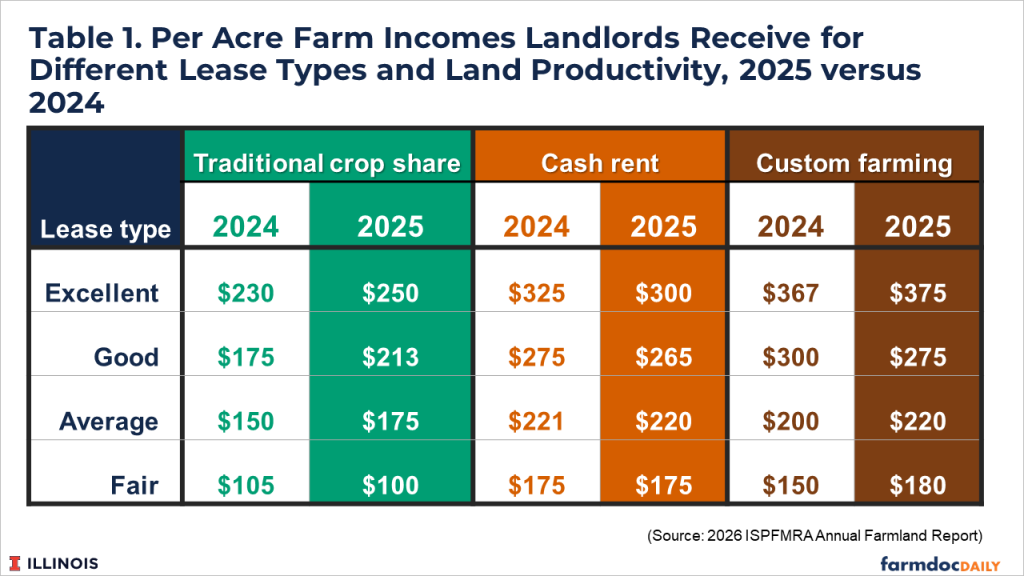
Excellent soils: Middle-third rents average $375/acre, with top-tier agreements reaching $400/acre.
Good soils: Average $325/acre.
Average soils: $273/acre.
Fair soils: $200/acre.
Despite slight declines in 2025 landlord incomes—particularly on cash‑rented acres—operators continue to compete aggressively for high‑quality ground, keeping rents elevated across productivity classes.
Leasing Performance in 2025 – Returns varied by lease structure:
Custom farming delivered the highest 2025 returns at $375/acre on excellent soils.
Cash rent averaged $300/acre.
Crop share averaged $250/acre, buoyed by strong yields and lower input costs.
These dynamics help explain why cash rents remain strong even as land values show signs of leveling.
Expectations for 2027 – Farm managers express cautious optimism:
67% expect 2027 cash rents to remain unchanged from 2026.
9% anticipate increases.
24% foresee modest softening.
Overall, the data points to a stable leasing market with limited downside pressure.
Why This Matters for Midwest Land Professionals
Illinois—one of our core reporting states—continues to set the tone for leasing trends across the Corn Belt. Strong operator demand, tight supply of high‑quality acres, and steady income expectations reinforce the importance of finalized sales and rental data when evaluating market conditions.
Illinois farmland values are entering a period of stabilization after several years of rapid appreciation. According to the latest ISPFMRA survey, most market participants expect modest softening in 2026, driven by tighter crop margins, elevated input costs, and a high‑interest‑rate environment. While 61% of respondents anticipate slight price declines, long‑term confidence remains strong, with 77% expecting higher values within five years. Transaction volumes are also cooling, and private treaty sales are regaining ground as buyers seek flexibility in a shifting market.
As one of Land Sales Bulletin’s reporting states, Illinois continues to demonstrate the importance of timely, accurate, and completed land sale data in understanding market sentiment and tracking regional trends across the Midwest.
Across the Midwest, farmland is more than acreage—it is heritage, livelihood, and the foundation of rural communities. Yet despite its importance, reliable information about what land actually sells for can be surprisingly difficult to find. That’s where Land Sales Bulletin plays a vital role.
For more than three decades, Land Sales Bulletin (LSB) has served as one of the Midwest’s most trusted sources for rural land sales. In a region where agriculture shapes local economies, family legacies, and community identity, LSB provides something essential: accurate, timely, recorded county‑level land sale data. Our data provides a clear, factual picture of the land market—free from speculation, rumor, or inflated auction chatter.
What Land Sales Bulletin Does
LSB focuses exclusively on recorded land sales of 20 acres or more, across 10 core Midwest states: Illinois, Iowa, Indiana, Michigan, Minnesota, Nebraska, North Dakota, Ohio, South Dakota, and Wisconsin, pulled directly from county courthouse records. This means:
No pending sales
No auction estimates
No unverifiable numbers
Just finalized, documented transactions that reflect real market activity.
Each sale includes county‑level detail—acres, price, land type, soil ratings, PINS, and buyer/seller information when available—giving farmers, landowners, brokers, lenders, appraisers, investors, and rural communities the transparency they need to make informed decisions.
Why This Matters to the Public
Even for residents who are not involved in agriculture, land sales influence daily life:
Local businesses depend on strong farm income.
Schools and infrastructure rely on stable property valuations.
Community planning requires understanding how land use is changing.
Economic development hinges on the health of rural land markets.
Accurate land‑sale reporting puts boots on the ground and helps ensure fairness, transparency, and informed decision‑making across the region.
The Human Story Behind Every Sale
Every land sale represents a turning point:
A retiring farmer passing land to the next generation
A young operator expanding to stay competitive
A family settling an estate
A community adjusting to new ownership
LSB’s role is to document these transitions with accuracy, timeliness and regard. By preserving the facts, LSB helps ensure that decisions—large and small—are grounded in facts.
Midwest Land Use: What the Data Shows
LSB’s 10 Midwest states remain among the most agriculturally productive in the nation. According to the 2022 USDA Census of Agriculture:
Iowa leads the region with nearly 30 million acres of farmland.
Nebraska, Illinois, Minnesota, and South Dakota each maintain more than 20 million acres.
North Dakota remains heavily agricultural, dominated by row crops and small grains.
Michigan and Ohio have smaller totals but maintain diverse production bases.
Wisconsin continues to balance dairy, forage, and specialty crops.
Across the region, one trend is clear: fewer farms, larger operations, and continued consolidation. Iowa was the only state in the group to gain farms between 2017 and 2022; all others saw declines.
When combined, LSB states contain roughly 260 million acres of farmland—representing nearly 30% of all U.S. farmland. That concentration underscores the Midwest’s role as the core of U.S. food, feed, and fuel production.
How Land Sales Bulletin Supports the Region
LSB’s subscriptions provide:
Completed, documented land sales of 20+ acres
State and county‑level detail on actual recorded sale transactions
Historical back data for market trend analysis
Reliable benchmarks for appraisals, lending, and estate planning
Consistent reporting across 10 states that anchor American agriculture
Because nearly one‑third of U.S. farmland lies within these states, LSB’s reporting helps shape national understanding of land values and market trends.
What Sets Us Apart
Our strength lies in our hands-on analysis of land sales data by local Midwest-trained land sales data specialists. This expertise ensures every documented land sale transaction is carefully reviewed and contextualized, providing unparalleled insight into the true market dynamics of the region. Our specialists bring knowledge and experience, making our data not just accurate, but actionable for farmers, landowners, realtors, lenders, investors, and appraisers alike.
Additionally, Land Sales Bulletin distinguishes itself through its commitment to transparency and consistency. We source data exclusively from official county courthouse records, ensuring that every sale reported is a complete, documented transaction. This rigorous approach eliminates speculation and provides stakeholders with trustworthy, timely information. Our ongoing dedication to quality makes us the Midwest’s most reliable land sales resource and choice for rural land sales data.
A Clearer Future for Midwest Land Markets
With rising farmland values, increasing investor participation, and ongoing consolidation, the need for transparent and documented land sale information has never been greater. Land Sales Bulletin is committed to delivering the clarity, consistency, and integrity Midwest rural real estate professionals rely on—supporting informed decisions and honoring the land and communities we serve.