High school student donates 7,000 lbs. of produce from own garden

accountMktgLSB | calendar-monthOctober 12, 2023


From nbc15.com:

WHEATLAND, Iowa (KWQC/Gray News) – A high school student in Iowa donated 7,000 pounds of produce from her own garden to various nonprofit organizations in the area.

In less than two years, she has donated about $15,000 worth of produce.

Junior Lauren Schroeder began her journey at a food drive during the COVID-19 pandemic when she noticed there wasn’t enough produce being given to community members.

In her sophomore year, Lauren’s family gave her a half-acre of land to start her own garden.

She was awarded a grant from the Future Farmers of America and was able to expand her garden to a full acre with a fence to protect crops from pests.

The garden includes over 20 types of produce including tomatoes, potatoes, peppers, squash, cauliflower, zucchini, broccoli, herbs and others.

“I want to impact community members,” Lauren said. “Many people help you out, but it makes more difference when you help other people out. That’s what makes me most happy.”

Lauren has spent over 1,000 hours working in the garden with help from her siblings and parents.

Her goal is to donate a total of 20,000 pounds of produce by the time she graduates high school in 2025.

Lauren plans to expand the garden and add organizations to her donation list through her first year of college.

Copyright 2023 KWQC via Gray Media Group, Inc. All rights reserved.
 

What’s next now that farm bill has expired?

accountMktgLSB | calendar-monthOctober 6, 2023

From farmprogress.com: 

As Congress brokered a surprise deal to avoid a government shutdown, the 2018 Farm Bill quietly expired. This leaves the fate of many federal agriculture and nutrition programs unclear until new legislation is passed. Despite this, farmers probably won feel any effects for at least a few months.

No farm bill means smaller initiatives like trade, research and rural development programs may pause or not make additional commitments. For example, the Conservation Reserve Program can continue making payments on existing contracts and enrolled acreage but may not be able to offer new enrollments. Some conservation efforts may be on hold. Others like the Working Lands Programs will continue after their funded was extended by the Inflation Reduction Act of 2022.

Crops insurance is permanently funded by the Federal Crop Insurance Act and will continue with or without a farm bill. The same goes for the Livestock Indemnity Program, the Livestock Forage Disaster Program, the Emergency Assistance for Livestock, Honeybees, and Farm-Raised Fish Program, and the Tree Assistance Program.

New Investors Enter the Field

accountMktgLSB | calendar-monthOctober 3, 2023

From Successful Farming:

Investment in farmland by high-profile billionaire buyers such as Bill Gates and Warren Buffett has prompted high-net-worth groups, most recently top professional athletes, to follow the trend to diversify their investment portfolio and hedge against inflation, experts say.

In January, about 25 athletes pooled $5 million in an agricultural investment fund to purchase farmland.  The first purchase was a 104-acre corn and soybean farm in northern Iowa, Front Office Sports reported.  The athletes, including the NFL’s Joe Burrow and NBA star Blake Griffin, plan to least the land to farmers and expect a single-digit-percentage annual return on the total investment.

The group seeks to buy four more farms within the next few years.  New York-based Patricof, which arranged the investment for the athletes, didn’t respond to questions about the price paid for the land or future purchases.  The investment firm’s website says it has “begun investing in farmland across the Corn Belt, the Pacific Northwest, and northern Minnesota.  The farms have high soil quality, strong crop yield, and grow row crops, which are planted annually, minimizing risk.  Farmland has historically provided stable annual income, and a solid hedge against inflation.”

Understand the Value of Investing in Farmland

accountMktgLSB | calendar-monthSeptember 29, 2023

From agriculture.com and authored by one of our valued customers, David Whitaker:

When it comes to investing in farmland, it’s essential to take the long-term approach. Farmland investments are typically held for the long term, as they are considered assets that appreciate over time. While there may be good years with great short-term returns, farmland investment is primarily a hold asset for the future. 

Factors Influencing Farmland Prices

accountMktgLSB | calendar-monthSeptember 20, 2023

From Successful Farming: 

Headlines boasting record-breaking farmland sales and surging values gave voice to the excitement in the market last year while land prices climbed. As 2023 marches on, the experts say some of that excitement may be waning and to expect strong, but flatter prices going forward.

                                                       PHOTO: KATIV, GETTY IMAGES

“We’ll probably see some high reports of really high-quality farms that are well-located…and we might see some lower-quality farms start to back up a little bit in prices as we head toward the end of the year,” says Tim Koch, executive vice president of business development for Farm Credit Services of America. “But as a whole, I would anticipate that we’ll see a flattening of prices throughout the remainder of the year.”

Jackson Takach, chief economist at Farmer Mac, put it this way: “You’re still seeing positive gains in land values, quarter over quarter, but at a much-reduced rate compared to ’21 or ’22, when they were in the double digits of annual and quarterly growth. Today they’re in the 1% to 3% range.”

Why Big Finance is Betting on Farmland

accountMktgLSB | calendar-monthSeptember 18, 2023

From farmprogress.com: 

                                            Photo: Holly Spangler

On the wind-swept plains of the heartland, an agricultural revolution is quietly underway. This one’s not led by advances in machinery or biotech, but rather by the inconspicuous behemoths of financial institutions: the institutional investor.

Who are these institutional investors?

Everyday individual investors make up the entities buying farmland, bringing together funds from people of various professions and backgrounds. Individual investors are people just like you and me: teachers, health-care workers, civil servants contributing to pension funds, or affluent individuals or families engaged with mutual funds or private equity funds. They can also be linked to religious, academic or cultural organizations with sizable endowments.

The attraction of institutional investment vehicles lies in their ability to unlock opportunities that would otherwise be unreachable for individuals.

Institutional investors leverage professional expertise, including financial advisers and fund managers, to make informed investment decisions. They employ a systematic approach to investing, involving rigorous analysis, complex strategies and risk management practices. They garner the benefits of scale, driving down costs, granting access to opportunities not available for smaller investors and potentially boosting returns for those who invest.

2023 WRA Convention

accountMktgLSB | calendar-monthSeptember 15, 2023

Are you planning to attend this year’s Wisconsin REALTORS Association Annual Convention? If so, we’ll see you there!

We’ll be parked in booth #214 with CamoAg. The perfect opportunity to see the comp tool redefining land sales & analysis. Get ready to rev past the competition!

The Wisconsin Realtors Association Annual Convention | October 1-3, Kalahari Resort, Wisconsin Dells

Information for Setting 2024 Cash Rents

accountMktgLSB | calendar-monthSeptember 14, 2023

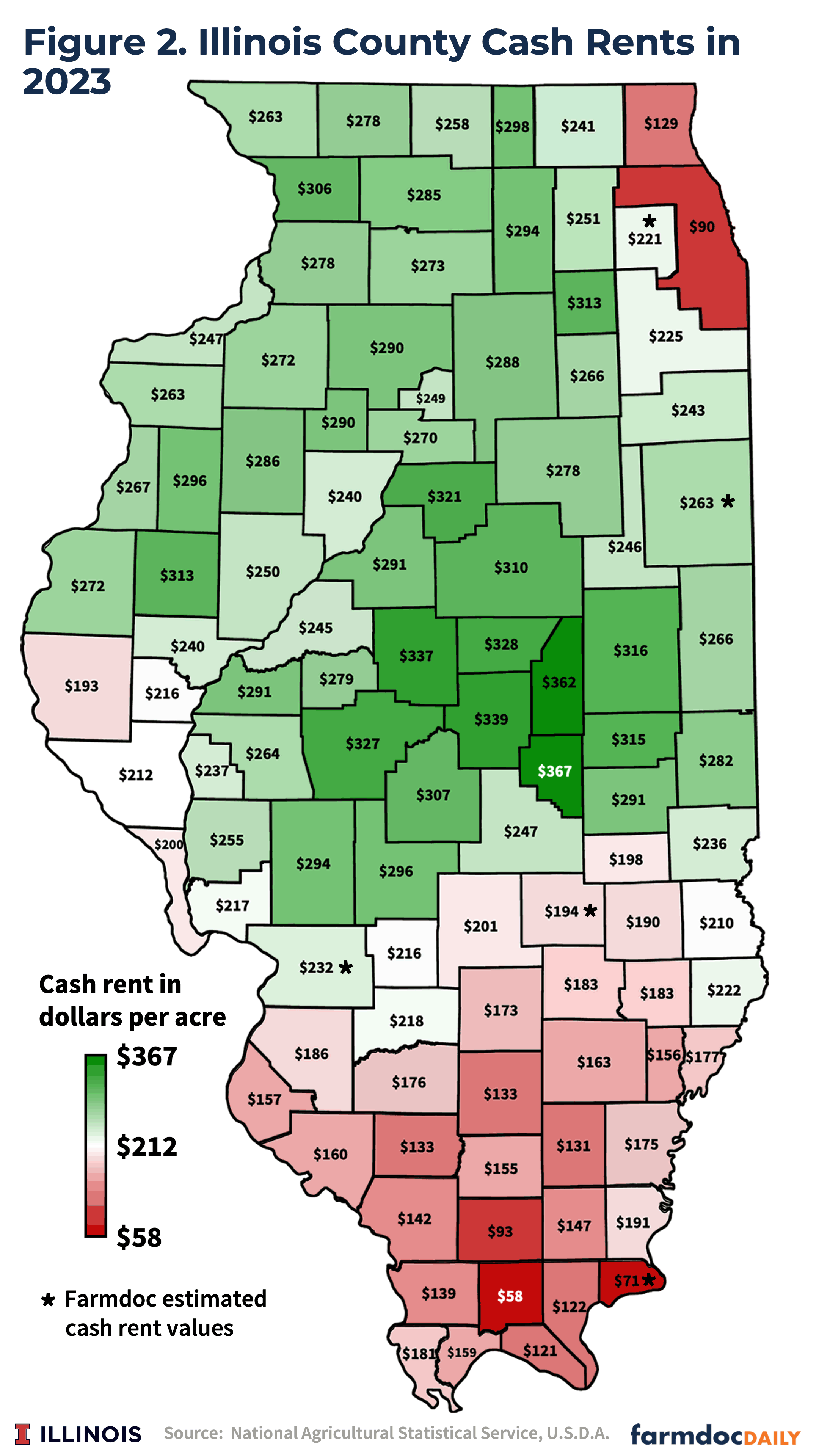
From farmdoc daily: The National Agricultural Statistics Service (NASS) recently released state and county rents for 2023. The Illinois Society of Professional Farm Managers and Rural Appraisers released their projections of 2024 rents on professionally managed farmland. Overall, cash rents increased from 2022 to 2023. Results from the Illinois Society survey suggest that cash rents may decline slightly from 2023 to 2024.

Cash rents vary across Illinois, as illustrated in Figure 2, which shows average county cash rents for non-irrigated cropland released by NASS on August 27. This year, NASS did not report cash rents for some major agricultural counties in Illinois. In Figure 2, rents for unreported counties were estimated based on a regression analysis, discussed below, relating rent levels to a county-level soil productivity index with agricultural district adjustment factors.

As is typical, cash rents are the highest in the central part of the state while cash rents are lower in southern Illinois. The highest reported average cash rent for 2023 is $367 per acre for Moultrie County. The second highest average rent is $362 for Piatt County. Moultrie and Piatt are adjacent counties in central Illinois and tied for the highest cash rent levels in Illinois in 2022 ($331 per acre).  The lowest cash rent reported for 2023 is $58 per acre in Johnson County, a county in southern Illinois which also had the lowest rent reported for 2022 ($53 per acre). See farmdoc daily from September 13, 2022 for last year’s average cash rent analysis.

Land Values Report Shows Stability After ‘Breakneck-Paced’ Growth

accountMktgLSB | calendar-monthSeptember 12, 2023

From agupdate.com: 

Compared to the last two years, the mid-year land values report, given by Luke Worrell chair of Land Values Conference, at the Farm Progress Show in Decatur on Aug. 30, was anti-climactic.

The snapshot of land values, sponsored by the Illinois Society of Professional Farm Managers and Rural Appraisers, shows stable land values in what he calls a “catch-your-breath” report after two years of a break-neck pace.

“It’s the first time in a long time I don’t have any crazy numbers to throw out,” Worrell said after land values increased between 40% and 50% in some cases during the last couple of volatile years.

“You can’t have 20% increases every year,” said University of Illinois ag economist Gary Schnitkey.

The report comes from a survey of Illinois Society members about what they saw in the first six months of the year and what they expect for the next six months. Not much has changed since the beginning of 2023, Worrell said.

Inflation and Recession Pressures: Is Farmland a Good Investment Right Now?

accountMktgLSB | calendar-monthSeptember 8, 2023

According to Bruce Sherrick, professor at the University of Illinois, you might not need to worry about what inflation is doing to your farmland values.

From AgWeb.com:  

The Federal Reserve is hosting its Economy Policy Symposium this week, which has all eyes on Jackson Hole Wyoming for further details on inflation, interest rates and if a recession is looming. But would a recession effect your operation the way you think? 

According to Bruce Sherrick, professor at the University of Illinois, you might not need to worry about what inflation is doing to your farmland values.

“Farmland returns are very highly correlated with inflation,” Sherrick says. “Most importantly, it has a positive correlation with inflation.”

Sherrick says this correlation is derived from the size and debt of the industry.

“Put the entire holdings of the country on one balance sheet and it’s now four trillion plus and only 13% leveraged, so 13% debt underneath it,” he says. “An interest rate change doesn’t have as big of a proportional impact as if you were talking about companies traded on the stock exchange, where the average leverage turns out to be around two-thirds.”

While the percentage of debt is low in comparison, he also highlights it’s mostly long-term, fixed-rate debt. Increasing interest rates won’t have as large of an impact on that, but it will decrease transactions.