2026 Illinois Farmland Price Expectations: Navigating a Stable Yet Softening Market

accountMktgLSB | calendar-monthApril 10, 2026

Illinois farmland values are entering a period of stabilization after several years of rapid appreciation. According to the latest ISPFMRA survey, most market participants expect modest softening in 2026, driven by tighter crop margins, elevated input costs, and a high‑interest‑rate environment. While 61% of respondents anticipate slight price declines, long‑term confidence remains strong, with 77% expecting higher values within five years. Transaction volumes are also cooling, and private treaty sales are regaining ground as buyers seek flexibility in a shifting market.

As one of Land Sales Bulletin’s reporting states, Illinois continues to demonstrate the importance of timely, accurate, and completed land sale data in understanding market sentiment and tracking regional trends across the Midwest.

Read more from farmdoc daily: farmdocdaily.illinois.edu

Report download: ISPFMRA Survey Report

Land Sales Bulletin: Bringing Clarity to Midwest Land Sales

accountMktgLSB | calendar-monthApril 9, 2026

Across the Midwest, farmland is more than acreage—it is heritage, livelihood, and the foundation of rural communities. Yet despite its importance, reliable information about what land actually sells for can be surprisingly difficult to find. That’s where Land Sales Bulletin plays a vital role.

For more than three decades, Land Sales Bulletin (LSB) has served as one of the Midwest’s most trusted sources for rural land sales. In a region where agriculture shapes local economies, family legacies, and community identity, LSB provides something essential: accurate, timely, recorded county‑level land sale data. Our data provides a clear, factual picture of the land market—free from speculation, rumor, or inflated auction chatter.


What Land Sales Bulletin Does

LSB focuses exclusively on recorded land sales of 20 acres or more, across 10 core Midwest states: Illinois, Iowa, Indiana, Michigan, Minnesota, Nebraska, North Dakota, Ohio, South Dakota, and Wisconsin, pulled directly from county courthouse records. This means:

  • No pending sales
  • No auction estimates
  • No unverifiable numbers

Just finalized, documented transactions that reflect real market activity.

Each sale includes county‑level detail—acres, price, land type, soil ratings, PINS, and buyer/seller information when available—giving farmers, landowners, brokers, lenders, appraisers, investors, and rural communities the transparency they need to make informed decisions.

Why This Matters to the Public

Even for residents who are not involved in agriculture, land sales influence daily life:

  • Local businesses depend on strong farm income.
  • Schools and infrastructure rely on stable property valuations.
  • Community planning requires understanding how land use is changing.
  • Economic development hinges on the health of rural land markets.

Accurate land‑sale reporting puts boots on the ground and helps ensure fairness, transparency, and informed decision‑making across the region.

The Human Story Behind Every Sale

Every land sale represents a turning point:

  • A retiring farmer passing land to the next generation
  • A young operator expanding to stay competitive
  • A family settling an estate
  • A community adjusting to new ownership

LSB’s role is to document these transitions with accuracy, timeliness and regard. By preserving the facts, LSB helps ensure that decisions—large and small—are grounded in facts.

Midwest Land Use: What the Data Shows

LSB’s 10 Midwest states remain among the most agriculturally productive in the nation.
According to the 2022 USDA Census of Agriculture:

  • Iowa leads the region with nearly 30 million acres of farmland.
  • Nebraska, Illinois, Minnesota, and South Dakota each maintain more than 20 million acres.
  • North Dakota remains heavily agricultural, dominated by row crops and small grains.
  • Michigan and Ohio have smaller totals but maintain diverse production bases.
  • Wisconsin continues to balance dairy, forage, and specialty crops.

Across the region, one trend is clear: fewer farms, larger operations, and continued consolidation. Iowa was the only state in the group to gain farms between 2017 and 2022; all others saw declines.

When combined, LSB states contain roughly 260 million acres of farmland—representing nearly 30% of all U.S. farmland. That concentration underscores the Midwest’s role as the core of U.S. food, feed, and fuel production.

How Land Sales Bulletin Supports the Region

LSB’s subscriptions provide:

  • Completed, documented land sales of 20+ acres
  • State and county‑level detail on actual recorded sale transactions
  • Historical back data for market trend analysis
  • Reliable benchmarks for appraisals, lending, and estate planning
  • Consistent reporting across 10 states that anchor American agriculture

Because nearly one‑third of U.S. farmland lies within these states, LSB’s reporting helps shape national understanding of land values and market trends.

What Sets Us Apart

Our strength lies in our hands-on analysis of land sales data by local Midwest-trained land sales data specialists. This expertise ensures every documented land sale transaction is carefully reviewed and contextualized, providing unparalleled insight into the true market dynamics of the region. Our specialists bring knowledge and experience, making our data not just accurate, but actionable for farmers, landowners, realtors, lenders, investors, and appraisers alike.

Additionally, Land Sales Bulletin distinguishes itself through its commitment to transparency and consistency. We source data exclusively from official county courthouse records, ensuring that every sale reported is a complete, documented transaction. This rigorous approach eliminates speculation and provides stakeholders with trustworthy, timely information. Our ongoing dedication to quality  makes us the Midwest’s most reliable land sales resource and choice for rural land sales data.

A Clearer Future for Midwest Land Markets

With rising farmland values, increasing investor participation, and ongoing consolidation, the need for transparent and documented land sale information has never been greater. Land Sales Bulletin is committed to delivering the clarity, consistency, and integrity Midwest rural real estate professionals rely on—supporting informed decisions and honoring the land and communities we serve.

Farmland values across the Midwest remain steady

accountMktgLSB | calendar-monthApril 6, 2026

Farmland values across the Midwest continue to hold steady—even inching upward in places—despite softer commodity prices and persistently high input costs. Recent insights from the Chicago Fed and the Iowa Realtors Land Institute show modest value increases across key crop districts, with tillable acres remaining especially resilient.

Industry experts point to several forces supporting today’s land market: limited supply, strong farmer demand, reinvestment through 1031 exchanges, and ongoing pressure from residential, commercial, and data‑center development. Farmland also remains a favored hedge against inflation, keeping buyers active even in a neutral interest‑rate environment.

At Land Sales Bulletin, we see these same dynamics across our 10‑state Midwest reporting region: Illinois, Indiana, Iowa, Michigan, Minnesota, Nebraska, North Dakota, Ohio, South Dakota, and Wisconsin. With only 1.5% to 2% of farmland changing hands annually in many states, competition for quality acres remains strong, and farmers continue to make up the majority of buyers.

A steady market doesn’t mean a quiet one—just a competitive one shaped by long‑term value and tight supply: farmprogress.com

Minnesota Farmland Market Holds Steady as 2026 Outlook Improves

accountMktgLSB | calendar-monthApril 1, 2026

Minnesota’s farmland market continues to demonstrate resilience heading into spring, supported by firmer commodity prices, USDA bridge payments, and improved grower sentiment. While demand isn’t at the peak levels seen from 2021–2023, values across the state remain steady, with recent sales showing strong productivity indexes and competitive per‑acre prices

As one of Land Sales Bulletin’s Midwest reporting states, Minnesota plays a key role in illustrating broader regional trends: moderated demand, lower sales volume compared to the boom years, and a market that continues to hold value despite higher interest rates and input cost uncertainty. With farmers entering the 2026 planting season facing more positives than negatives, Minnesota’s land market remains a steady anchor in the Midwest. Read more from Farm Progress: Demand for Minnesota farmland holds steady as outlooks improve

Minnesota land sales - Farm Progress

Midwest Notable Farmland Sales March 2026

accountMktgLSB | calendar-monthMarch 30, 2026

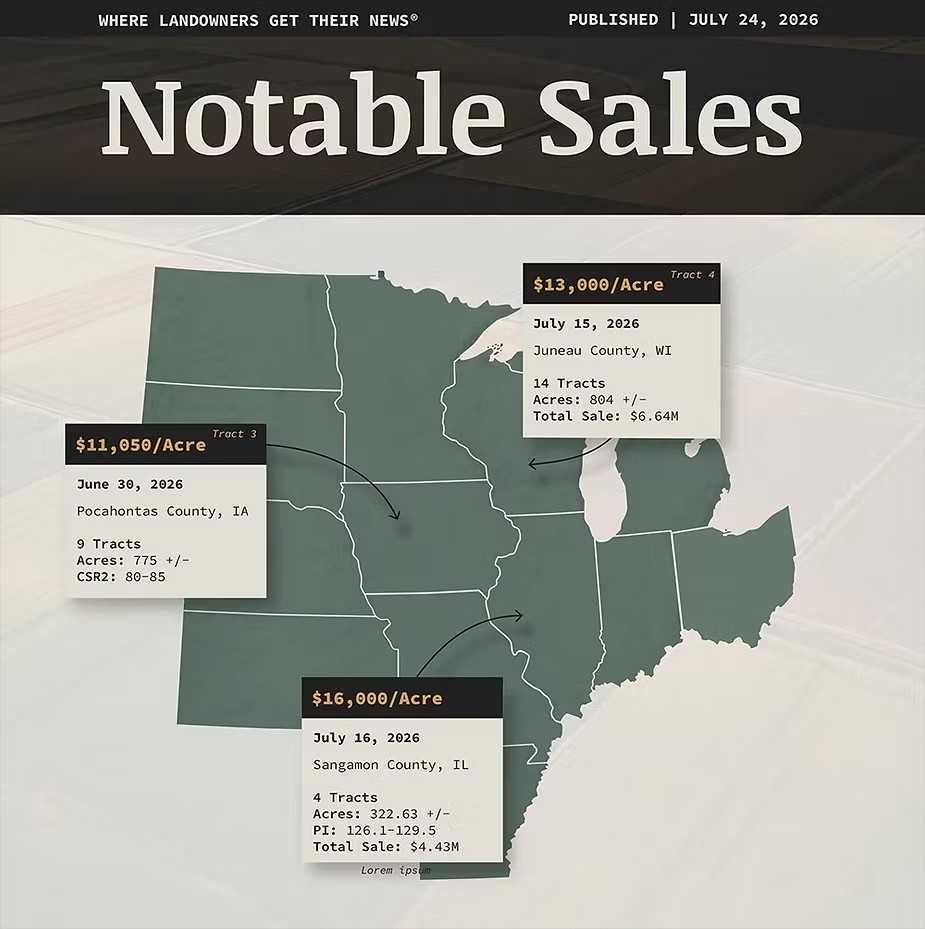
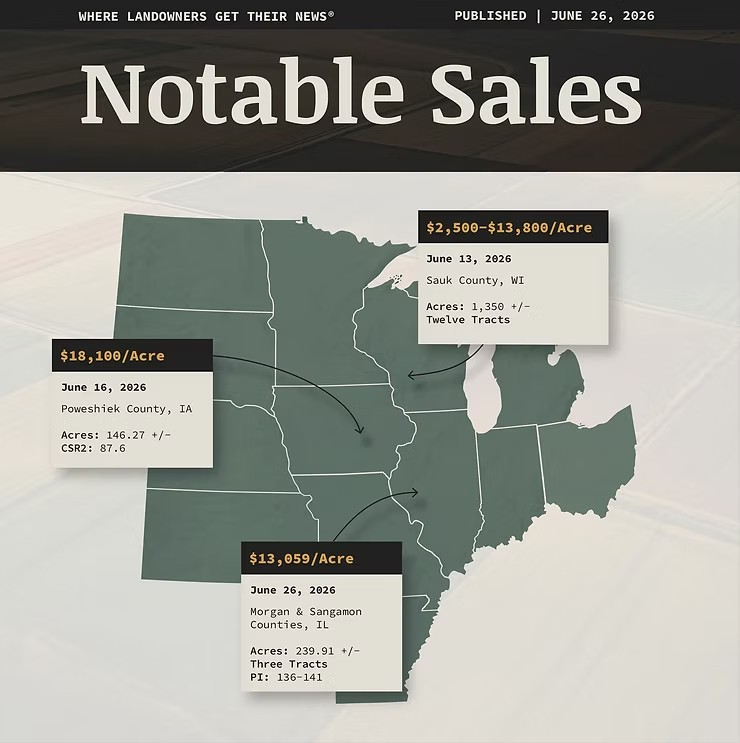
Our Midwest reporting states of Illinois, Iowa, and Nebraska are the featured farmland sales in American Farmland Owner‘s recent Notable Sales report.

Farmland auctions across the 3 featured states show prices from $11,500 to $22,100 per acre, driven by soil quality, productivity, and location. Read details behind each sale https://www.americanfarmlandowner.com/post/midwest-notable-farmland-sales-march-2026

Farmland Values Hold Firm Across the Midwest Despite Weaker Farm Finances

accountMktgLSB | calendar-monthMarch 26, 2026

American Farmland Owner reports on the New Federal Reserve surveys that show farmland values across the Midwest held steady or increased in 2025, reinforcing the strength of the region’s land market even as farm finances weakened.

For those following Land Sales Bulletin’s 10-state Midwest region—Illinois, Indiana, Iowa, Michigan, Minnesota, Nebraska, North Dakota, Ohio, South Dakota, and Wisconsin—the data highlights continued stability:

  • Chicago Fed District: Farmland values up 6% year over year
    • Indiana +9%
    • Wisconsin +9%
    • Iowa +7%
    • Illinois +3%
  • Kansas City Fed District:
    • Non‑irrigated land: –0.3%
    • Irrigated land: +1.2%
    • Ranchland: +4.1%

At the same time, repayment challenges increased, more banks tightened credit standards, and interest rates—while easing—remain above long‑term averages.

Even with these pressures, Midwest farmland continues to stand out as one of the most stable assets in the agricultural economy. Read more: americanfarmlandowner.com

Midwest Farmland Values – “The Selective Strength” Era

accountMktgLSB | calendar-monthMarch 24, 2026

Nick Westgerdes, AFM, owner of New Roots Farm Brokerage, shares specialized farmland value insights and management reports for our Midwest reporting states of Illinois and Wisconsin. As the current President-Elect of the Illinois Society of Professional Farm Managers and Rural Appraisers (ISPFMRA), his recent 2026 reports highlight a “resilient” but evolving market using our Illinois and Wisconsin land sales data. New Roots Farm Brokerage – Client Driven & Farm Focused.

Nebraska Farmland Values Hold Steady Amid Market Shifts

accountMktgLSB | calendar-monthMarch 19, 2026

Our Midwest state of Nebraska continues to demonstrate why it remains a cornerstone of Midwest farmland performance. According to the University of Nebraska–Lincoln’s latest survey, the statewide all‑land average value sits at $3,905 per acre in 2026, a modest 1% decline from the previous year. This marks the second consecutive year of slight softening after Nebraska reached a record high in 2024.

Survey respondents point to lower commodity prices, higher input costs, and elevated interest rates as the primary pressures on land values. Even so, Nebraska’s market remains resilient, with grazing land and hayland values rising 4–7% statewide, supported by strong cattle prices and competition for pasture. Irrigated and dryland cropland values saw small declines, generally between 1–3% depending on land class and region. Nebraska Farm Real Estate Report | Center for Agricultural Profitability | Nebraska

For those tracking Nebraska’s land market closely, two reports are now available for download:

These insights complement what Land Sales Bulletin continues to document across its 10‑state Midwest region: tight supply, strong buyer competition for quality acres, and a market that remains steady even as financial conditions shift.

Nebraska Land Market Shows Quiet Strength

accountMktgLSB | calendar-monthMarch 12, 2026

Nebraska continues to demonstrate why Midwest farmland market remains one of the most resilient asset classes. Despite softer commodity prices, verified sales across the state show values holding firm — a trend echoed across Land Sales Bulletin’s Midwest reporting region.

Recent Nebraska transactions highlight the diversity of demand:

  • Greeley County pasture brought $3,600/acre, supported by recreational appeal and steady local interest.
  • Platte County pivot‑irrigated cropland surged to $14,650/acre, reflecting the premium placed on high‑quality, rarely available acres.
  • Merrick County irrigated tracts sold between $7,700 and $8,300/acre, buoyed by strong soybean yields, excellent access, and reliable water infrastructure.

Nebraska’s mix of irrigated productivity, livestock supported regions, and limited turnover keeps values supported — and reinforces the broader regional story of resilience. Read more from Farm Progress: Resilience of land markets is a surprise