FarmDoc Daily Illinois Report: Farmland Prices and Government Programs July 7, 2026

accountJennifer Moran | calendar-monthJuly 9, 2026

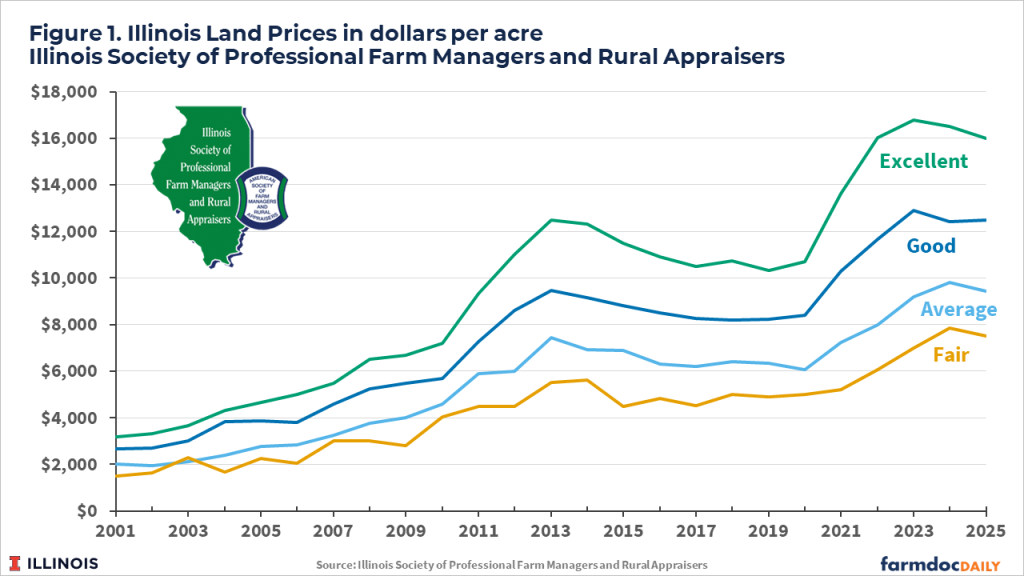
Illinois farmland values rose sharply from 2020 to 2023, then held steady or eased slightly through 2025, even as farmer returns fell and turned negative on many cash‑rented acres. Excellent‑productivity farmland climbed 57 percent during the upswing, then declined only 5 percent from its 2023 peak.

Cash rents followed a similar pattern, rising quickly during strong return years, then barely adjusting downward when returns weakened.

Federal programs, including crop insurance, ARC and PLC, and recent ad hoc assistance, continue to buffer income and slow cost‑structure adjustments across Illinois agriculture.

These dynamics explain why farmland prices have not retreated meaningfully and why rent negotiations remain tight heading into 2026 for our Midwest reporting state of Illinois.

Read more from FarmDoc Daily: https://farmdocdaily.illinois.edu/2026/07/farmland-prices-and-government-programs.html

Download their report (PDF): https://farmdocdaily.illinois.edu/wp-content/uploads/2026/07/fdd070726.pdf

Summer 2026 Farmland Values: Stability Across Illinois, Iowa, Minnesota & Nebraska

accountJennifer Moran | calendar-monthJuly 1, 2026

Farmland values across Land Sales Bulletin’s Midwest reporting region continue to show steady, resilient performance heading into Summer 2026, according to Hertz Farm Management’s latest update.

  • Iowa remains stable, with farmland values increasing 1.3% from September 2025 to March 2026 . Over the past 12 months, Iowa posted a net 0.3% gain after a brief dip earlier in 2025.
  • Illinois shows a choppy‑sideways trend. “Excellent” quality land declined 3%, while “Good” and “Average” land remained flat and “Fair” land increased 2% . Despite near‑term caution—61% of respondents expect prices to decline in 2026 —values remain 49–54% above 2020 levels.
  • Nebraska cropland values softened, declining 1–3% statewide, while grazing land rose up to 7% on strong cattle prices . Overall agricultural land values fell 1% year‑over‑year, marking a second consecutive annual decline.
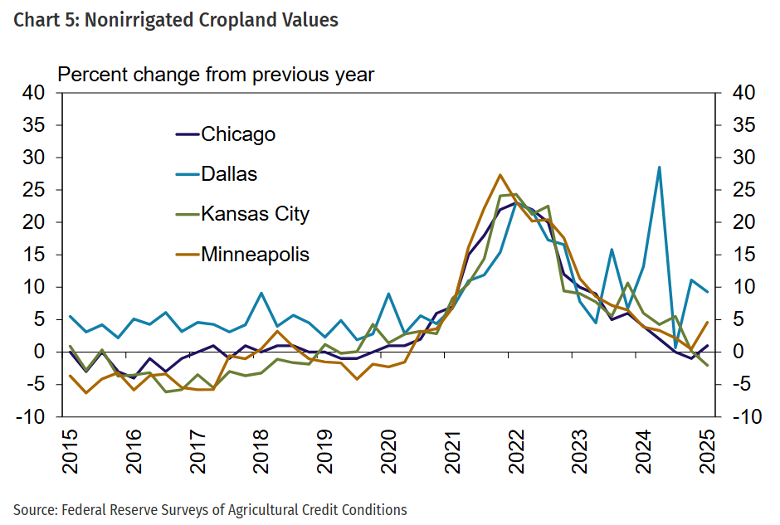
  • Minnesota remains resilient, with modest increases in non‑irrigated cropland prices and ranchland rents, while irrigated rents declined . Lenders remain cautious, with 64% expecting farm incomes to decrease in the year ahead.

Across the Corn Belt, limited land supply, steady buyer interest, and stable long‑term fundamentals continue to support values despite tighter margins and broader economic volatility. Read more from Hertz Farm Management: https://www.hertz.ag/blog/detail/farmland-values-update-summer-2026

South Dakota Farmland Market Update: Stability Driven by Local Demand

accountJennifer Moran | calendar-monthJune 12, 2026

South Dakota continues to demonstrate steady strength and stability in the Midwest farmland market, supported by limited supply, strong operator interest, and stable cash rents. As one of Land Sales Bulletin’s Midwest reporting states, South Dakota remains a key region where finalized sales data helps producers, lenders, and landowners understand real-time market conditions.

Recent insights from ASFMRA‘s South Dakota Ag Update highlight several consistent themes. High-quality tracts continue to draw competitive bidding, with local producers leading most purchases. Investor activity remains present but secondary to operator demand. Cash rents are holding firm across much of the state, supported by strong balance sheets and the ongoing scarcity of acres coming to market.

With planting season progressing and producers optimistic about field conditions, the overall outlook remains steady. Limited supply continues to be the defining factor supporting values, even as margins tighten and operating costs rise.

Tune in to learn more in ASFMRAs South Dakota Ag Update.

Land Sales Bulletin will continue to track finalized sales across South Dakota and the broader Midwest to keep the market informed.

How Money Supply and Inflation Shape Midwest Farmland Values

accountJennifer Moran | calendar-monthMay 14, 2026

Inflation and money supply have always played an outsized role in shaping farmland markets — but their impact is especially visible across the Midwest. As the article notes, inflation erodes the purchasing power of cash, making productive assets like farmland more attractive to both farmers and investors.

Over the past decade, the U.S. money supply (M2) expanded dramatically, rising from roughly $13 trillion in 2016 to more than $22 trillion today. Much of this growth occurred during 2020–2022, when emergency fiscal spending and Federal Reserve liquidity programs injected unprecedented capital into the financial system. Read more from Farm Progress: How-does-inflation-impact-land-values

For our Midwest farmland, this matters for three reasons:

  1. Inflation expectations drive demand for hard assets
    As more dollars circulate, the value of each dollar declines. The article highlights that this environment rewards asset owners and penalizes those holding cash. Farmland — with its scarcity, income potential, and long‑term stability — becomes a preferred inflation hedge.
  1. Liquidity fuels buying power
    When credit is abundant, more buyers can compete for a limited supply of acres. This dynamic has supported strong appreciation across the Midwest, where local operators remain the dominant buyers.
  1. Midwest land responds through interest rates, not speculation
    Unlike coastal real estate or equities, Midwest farmland values are most sensitive to interest rates, which are directly influenced by money supply trends. When M2 expands, rates tend to fall — supporting land purchases. When M2 slows, rates rise — moderating price growth.

Even as inflation cools and financial conditions tighten, the Midwest continues to show resilience. Scarcity, strong balance sheets, and productive yield help farmland hold value even when liquidity contracts.

In short: M2 sets the financial backdrop. Interest rates transmit the impact. Midwest farmland absorbs it in a steady, disciplined way.

How does inflation impact land values? Farm Progress May 13, 2026

Farmland Values Across the Upper Midwest

accountJennifer Moran | calendar-monthApril 8, 2026

Farmland values across the Upper Midwest continue to be defined by one theme: stability. Despite tighter margins and higher production costs, producers in our Midwest reporting states of Nebraska, Iowa, and South Dakota remain supported by strong balance sheets and historically limited land supply.

The article highlights meaningful differences across the region. Iowa is seeing lower auction volume and modest softening in returns. Nebraska remains steady, with high‑quality tracts still drawing strong interest. South Dakota stands out as the exception, posting increased sales activity and double‑digit gains in pastureland values over the past year.

Local buyers continue to dominate the market, and financing is becoming a more common strategic tool. With supply still constrained and fundamentals holding firm, the Midwest land market remains balanced and resilient — a story where stability itself is the headline. Farm Progress: Here’s the secret to steady farmland values