Midwest Farmland Values Rise Moderately Across the Seventh Federal Reserve District

accountJennifer Moran | calendar-monthNovember 13, 2026

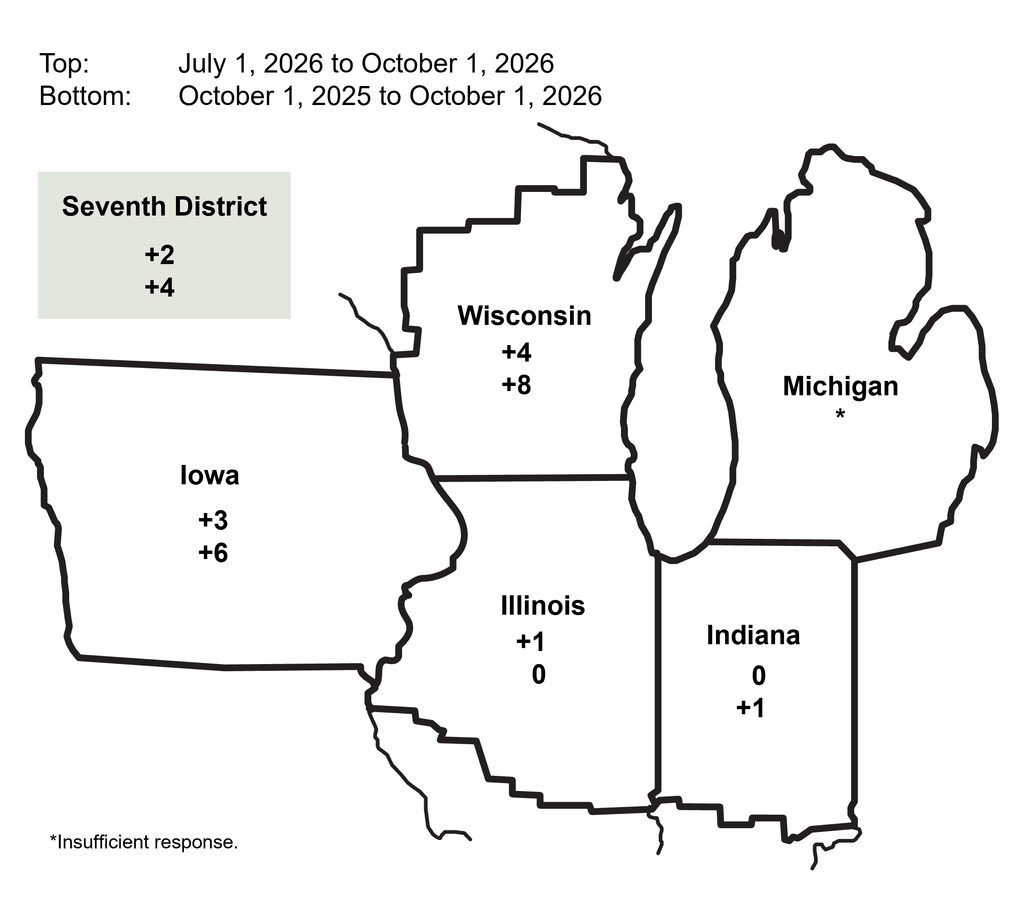
Midwest farmland values continued to show stability during the third quarter of 2026, according to the latest Agletter covering the Chicago Seventh Federal Reserve District. The report points to moderate gains in agricultural land values across much of the Midwest while lenders reported ongoing pressure on farm credit conditions.

For landowners, investors, farmers, and industry professionals across Illinois, Indiana, Iowa, and Wisconsin, the report provides a timely snapshot of farmland market activity and agricultural lending trends in some of our Midwest’s most closely watched land markets.

Midwest Highlights

  • Seventh District farmland values increased 4% from a year earlier
  • Good farmland values rose 2% from the previous quarter
  • Indiana, Iowa, and Wisconsin recorded annual land value gains
  • Illinois farmland values remained stable year-over-year
  • Agricultural loan demand stayed above year-ago levels
  • Farm loan repayment rates continued to weaken
  • More lenders reported loan renewals and extensions
  • Nonfarm investor interest in Midwest farmland remained active

The Agletter was authored by David Oppedahl and Elizabeth Kepner of the Federal Reserve Bank of Chicago. Their analysis indicates that Midwest farmland values remain supported despite ongoing challenges tied to farm income, lending conditions, and producer profitability.

As Land Sales Bulletin continues its focus on Midwest land markets, the latest data underscores the long-term strength of agricultural real estate across the Seventh Federal Reserve District. While credit conditions remain a concern, farmland values throughout much of our Midwest continue to demonstrate resilience heading toward 2027.

Full Report:Chicago Seventh Federal Reserve District Agletter – Third Quarter Midwest Farmland Values Moved Up Moderately

Midwest Farmland Watch: Early Illinois Sales Hint at Stabilizing Values

accountJennifer Moran | calendar-monthOctober 23, 2026

Across the Midwest, early fall sales in Illinois are offering a clearer read on where farmland values may be heading. Land Sales Bulletin continues to track these regional shifts closely, and Illinois is showing some of the first signs of stabilization after a slower midyear period. Stronger commodity prices since August and solid yields in several Illinois regions are helping support buyer confidence, even as overall sales volume remains lighter than last year.

Highlights

  • Class A farmland in central Illinois showing stronger bidding activity
  • Select Class A tracts improving by one to two thousand dollars per acre
  • Local buyers driving interest on high productivity acres
  • West central Illinois seeing high income producing farms outperform expectations
  • Some sales reaching high teens to twenty thousand per acre though not typical statewide
  • Strong corn and soybean yields supporting buyer optimism
  • Northern and southern Illinois reporting fewer auctions and slower seasonal starts

Farm Progress provides the full Midwest report. Read it here: https://www.farmprogress.com/farm-business/are-illinois-farmland-values-rebounding-

Midwest Farmland Watch: Early Illinois Sales Hint at Stabilizing Values

Minnesota Farmland Sales Slow in 2026, but Year-End Could Shift the Story

accountJennifer Moran | calendar-monthOctober 22, 2026

Southeastern Minnesota’s farmland market has been quieter through 2026, yet values for Land Sales Bulletin’s Midwest reporting state continue to show strength even with fewer finalized sales. Compeer Financial’s appraisal team notes that activity across Dakota, Le Sueur, Rice, Goodhue, Wabasha, and Dodge counties is well below last year’s pace, but the fourth quarter may close that gap as farmers wrap up harvest and evaluate year-end decisions.

Key Highlights

  • Farmland sales across six southeastern Minnesota counties are down sharply from 2025, with just 55 qualifying transactions so far.
  • Despite slower activity, values remain resilient, rising approximately 5% year over year and 21% over the past four years.
  • County averages vary widely, from $11,000 to $11,500 per tillable acre in much of the region, up to nearly $14,500 in Dodge County.
  • Strong yields in parts of Minnesota may help offset weaker commodity prices as farmers assess their financial position heading into 2027.
  • Solar projects, suburban expansion, and recreational land demand continue to influence values across southeastern Minnesota.
  • Year-end sales activity, typically strongest from November through February, could significantly narrow the gap between 2025 and 2026.

Compeer Financial’s appraisal team, including author Aaron Stark, continues to monitor our Midwest reporting state of Minnesota’s evolving land market closely. Listen or read their full report: https://www.compeer.com/articles/southeastern-minnesota-farmland-sales-slow-in-2026

Indiana Farmland Values Enter a Period of Stabilization

accountJennifer Moran | calendar-monthOctober 14, 2026

Indiana farmland values are leveling out after several years of rapid price movement, according to the latest Purdue Farmland Values and Cash Rents Survey. After notable swings in 2024 and 2025, statewide values in 2026 show signs of moderation as the market digests uncertainty and shifting development pressures across the region. For Land Sales Bulletin readers, this aligns with broader Midwest trends we continue to monitor across our reporting states, including Indiana.

Key Points

  • Statewide farmland values dipped in 2026 following large leaps in prior years
  • Average-quality Indiana farmland now sits at $12,121 per acre, down 1.1%
  • Top-quality and poor-quality ground show little change from June 2025 levels
  • Development pressure from housing, renewable energy and data centers is driving localized price spikes
  • Eastern Corn Belt states, including Indiana, continue to see a “halo effect” from commercial expansion
  • Crop price improvements since June are supporting expectations for firmer land values heading into 2027

Indiana’s mix of steady agricultural demand and rising non-ag development interest underscores the variability landowners may continue to see in the coming years. As always, Land Sales Bulletin will track these shifts closely across our Midwest reporting states.

Author: Allison Lynch, Indiana Prairie Farmer Source: Farm Progress Report link: https://www.farmprogress.com/farm-business/indiana-farmland-values-stabilize-following-large-leaps

Indiana Farmland Values – American Farmland Owner

accountJennifer Moran | calendar-monthSeptember 18, 2026

Our Midwest reporting state of Indiana’s farmland market continues to show a mixed pattern heading into late 2026, according to American Farmland Owner.

Dr. Todd Kueth of Purdue University notes that while there is no crash underway, slight depreciation could emerge as the year closes.

Key forces shaping Indiana’s market include:

  • Expectations for lower crop returns and higher interest rates, both applying downward pressure on values
  • Limited land availability, which continues to support prices despite broader economic headwinds

Market movement across Indiana mirrors trends seen in other Midwest states:

  • Top‑quality farmland: $14,909/acre, up 0.6% year over year
  • Average‑quality farmland: down 1.1% to $12,121/acre
  • Poor‑quality farmland: down 3.1% to $9,460/acre

Kueth notes this pattern resembles the 2014–2019 stabilization period following rapid growth, with statewide values still well above historical averages after a decade of appreciation.

The Purdue report also highlights:

  • A price‑to‑rent ratio substantially above historical levels, suggesting farmland prices may be high relative to income generated by the land
  • Historically, high price‑to‑rent ratios have aligned with lower subsequent returns for investors
  • While low land availability and farmland’s role as an inflation hedge continue to support values, lower net farm returns and higher interest rates may add pressure ahead

Indiana remains a core Midwest reporting state for Land Sales Bulletin, and these trends will be closely watched as 2026 progresses.

Full article by Dave Price via American Farmland Owner: https://www.americanfarmlandowner.com/post/indiana-land-values-could-fall-slightly-in-late-2026

Federal Reserve’s 7th District Shows Flattening Farmland Values as Credit Pressures Rise

accountJennifer Moran | calendar-monthSeptember 14, 2026

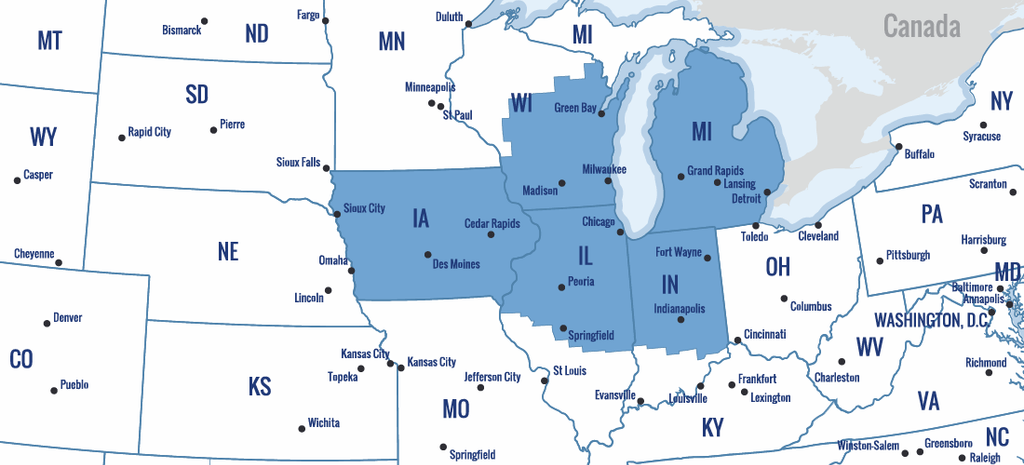
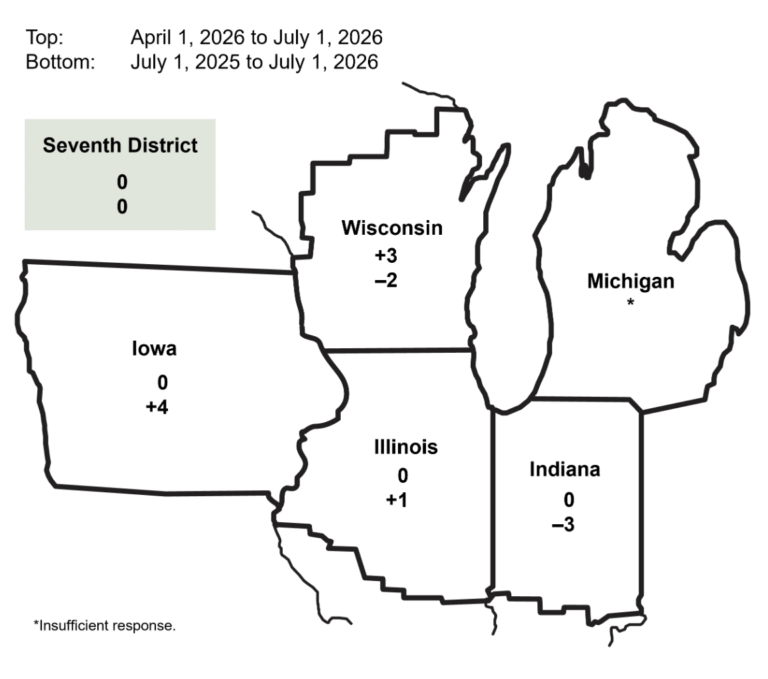
Farmland values across the Federal Reserve’s 7th District held steady in the second quarter of 2024, marking the slowest growth since late 2024, according to Farm Progress reporting based on a survey of 79 agricultural lenders . The district covers several of Land Sales Bulletin’s Midwest reporting states, including Iowa, northern Illinois, Indiana, southern Wisconsin, and Michigan’s lower peninsula .

Highlights

  • Iowa led the region with a 4% annual gain in farmland values .
  • Illinois posted a modest 1% increase, while Indiana values declined 3% and Wisconsin fell 2% .
  • When adjusted for inflation, district farmland values declined 3.71% year over year, the largest real drop since Q3 2016 .
  • Non‑ag buyers, including solar and data center developers, continue influencing land markets across the Midwest states .
  • Credit concerns are mounting, with major or severe repayment problems rising to 3.7% of district farm loans, the highest level since 2020 .
  • Not a single lender reported improved repayment rates compared to last year, and 27% indicated repayment rates are declining .

Farmland values may be flattening, but credit pressures are building across the Midwest. For LSB’s reporting states, the combination of stable nominal values and rising financial stress underscores the importance of monitoring both land markets and lending conditions heading into 2027.

Listen or Read more from Farm Progress: https://www.farmprogress.com/farm-business/farmland-values-flatten-as-credit-concerns-mount

Federal Reserve’s 7th District Map

U.S. Farmers Highlight Long-Term Value and Family Ties in Farmland Ownership

accountJennifer Moran | calendar-monthSeptember 11, 2026

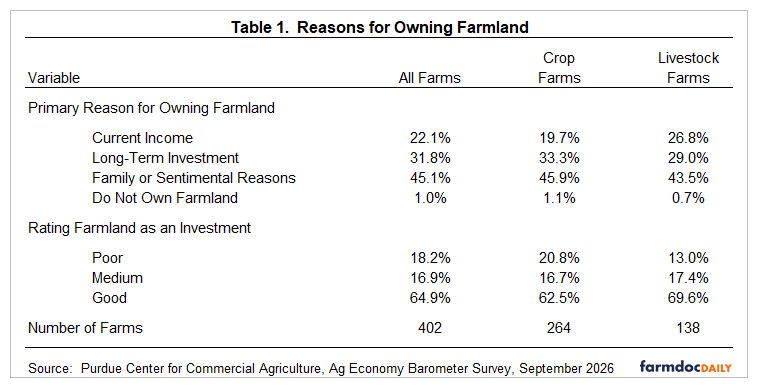
New analysis from farmdocDaily examines why U.S. farmers own farmland and how they view future land values, drawing on results from the August 2026 Purdue University-CME Group Ag Economy Barometer survey. Responses from approximately 400 producers underscore the unique role farmland plays across the Midwest and beyond.

Report Highlights:

  • Family or sentimental reasons were the top motivation for owning farmland, cited by 45 percent of respondents
  • Long-term investment ranked second at 32 percent, followed by current income at 22 percent
  • Two-thirds of producers indicated farmland is a good investment
  • Producers were more optimistic about farmland values five years out than over the next 12 months
  • Alternative investments and interest rates were identified as the most influential factors affecting farmland values

The full farmdocDaily report is available for download.
Authors: Michael Langemeier and Joana Colussi
Report Link: why-u-s-farmers-own-farmland-and-what-they-expect-for-land-values.html

Why U.S Farmers Own Farmland and What They Expect for Land Values

Illinois Farm Real Estate Values Rise for the Sixth Consecutive Year

accountJennifer Moran | calendar-monthAugust 25, 2026

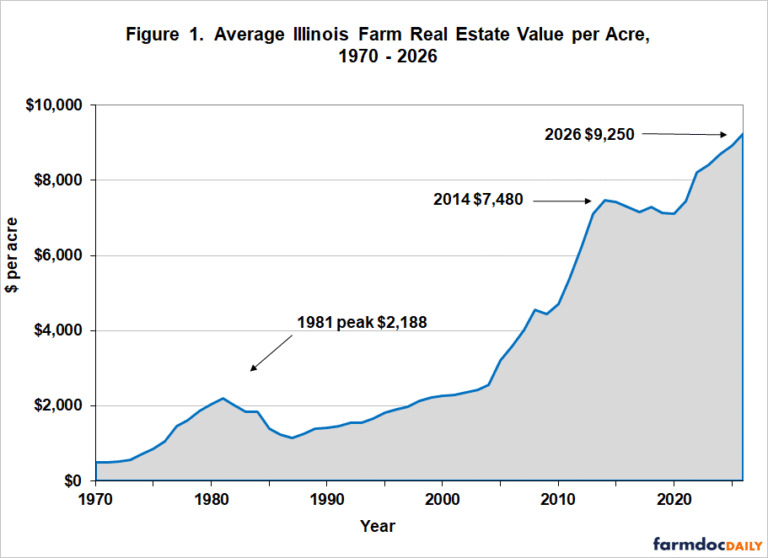
Illinois farm real estate values continued their upward trend in 2026, marking the sixth straight year of gains. According to the latest USDA NASS Land Values Summary, Illinois reached an average of $9,250 per acre in 2026, a 3.6 percent increase over 2025. This steady growth aligns with broader Corn Belt movement, where LSB;s Midwest and neighboring states also posted moderate increases.

Midwest State Highlights

  • Illinois: $9,250 per acre in 2026, up 3.6 percent from 2025; sixth consecutive annual increase
  • Iowa: 3.2 percent increase; highest regional value at $10,100 per acre
  • Indiana: 3.4 percent increase
  • Missouri: 4.0 percent increase
  • Ohio: 3.2 percent increase; second highest value at $9,650 per acre

Illinois previously held the top position in 2021, but stronger gains in Iowa and Ohio over the last five years have shifted regional rankings.

Full Report from: farmdoc daily, University of Illinois: https://farmdocdaily.illinois.edu/2026/08/illinois-farm-real-estate-values-increase-six-years-in-a-row.html

Eastern Wisconsin Farmland Values Rise with Dairy Demand

accountJennifer Moran | calendar-monthAugust 21, 2026

Compeer Financial’s latest report from author Jeff Jens highlights one of the strongest year over year increases in our Midwest region. Dairy operators continue to compete for nearby cropland, tightening supply and supporting premium prices across eastern Wisconsin. As one of Land Sales Bulletin’s valued customers, Compeer Financial provides essential insight into the market forces shaping farmland values across our Midwest states.

Midwest State Highlights

  • Wisconsin: limited cropland availability and strong dairy demand continue to push values higher. Calumet County benchmark cropland rose about 25 percent year over year, with multiple 2026 sales exceeding $20,000 per acre and one reaching $24,000 per acre.
  • Minnesota: dairy influenced competition persists in regions where feed production and facility upgrades mirror Wisconsin’s operational needs.
  • Iowa: strong livestock sectors and tight supply of high-quality cropland continue to support firm operator driven values across the state.

Key Market Drivers

  • Nearby cropland helps dairies control long term operational costs by reducing hauling distance for feed and manure.
  • Limited land availability in east central Wisconsin ensures strong buyer competition whenever quality acres come to market.
  • Dairy facility upgrades and multi-site operations continue across the region, influenced by construction costs and long-term growth planning.
  • Solar, wind, and data center development add complexity to rural land markets and can redirect capital into agricultural purchases elsewhere.

Compeer Financial’s full report provides deeper context on how dairy economics, construction costs and broader market pressures continue to shape land values across Wisconsin and the Midwest. Listen or read the full article by Jeff Jens: https://www.compeer.com/articles/wisconsin-farmland-values-rise-with-dairy-demand

Inflation-Adjusted Midwest Farmland Values See Steepest Drop Since 2016

accountJennifer Moran | calendar-monthAugust 19, 2026

Midwest farmland values in our Midwest reporting states, showed their sharpest inflation-adjusted decline in a decade, according to the latest Chicago Fed AgLetter published by the Federal Reserve Bank of Chicago. While nominal values for good farmland held steady year-over-year, real values fell 3.7 percent — the largest drop since 2016 . Lenders across the region also reported weakening credit conditions and rising repayment challenges.

Midwest State Highlights (LSB Reporting States):

  • Illinois: Year-over-year farmland values increased, supported partly by outside investment activity including solar and data centers.
  • Indiana: Farmland values decreased year-over-year as credit conditions weakened and repayment issues rose.
  • Iowa: Values increased year-over-year, though lenders noted commodity price volatility and elevated production expenses weighing on conditions.
  • Wisconsin: Values decreased year-over-year, with lenders noting outside pressure from solar and data center demand may eventually plateau.

Only 5 percent of lenders expect farmland values to rise in the next quarter, while 81 percent anticipate stability and 14 percent expect declines.

Publisher: Farm Policy News

Report link: https://www.chicagofed.org/publications/agletter/2025-2029/august-2026