Nebraska Farmland Sales Hold Steady Across Key Regions

accountJennifer Moran | calendar-monthJuly 6, 2026

Nebraska’s land market continues to show strength this summer, even with limited inventory. According to Farm Progress, high‑quality farms remain in demand, with more buyers than sellers across the state.

Representative sales from five counties highlight the range of values and land types moving this season.

  • Garden County (Panhandle): 159.59 acres sold for $1,785/acre, featuring superior soils and strong ag plus recreational potential
  • Merrick County (East): 78.08 acres sold for $9,925/acre, a well‑managed Platte Valley irrigated farm with excellent water access
  • Lancaster County (Southeast Lincoln area): 124.06 acres sold for $18,499/acre, driven by transitional development potential and strong location advantages
  • Hall County (Central): 76.54 acres sold for $11,039/acre, positioned near strong grain markets and an ethanol plant
  • Johnson County (Southeast): 160 acres sold for $10,500/acre, with 96% tillable acres and completed conservation work

Nebraska remains a core state in Land Sales Bulletin’s Midwest reporting region, and these sales reflect a market where quality land continues to attract strong buyer interest. Farm Progress: Farmland sales hold steady across Nebraska

Minnesota Farmland Snapshot: Recent Sales Across Key Counties

accountJennifer Moran | calendar-monthJuly 2, 2026

Minnesota’s farmland market continues to show resilience heading into the second half of 2026, supported by recent sales across several counties statewide. While values have softened slightly, the market remains stable, with widening gaps between excellent and moderate-quality tracts as buyer demand shifts.

3 Key Things to Watch in the Second Half of 2026

  • 2026 Crop Outlook — In‑season yield expectations will heavily influence farmer optimism and market aggressiveness
  • Geopolitics — War, trade, interest rates, and tariffs continue to shape commodity prices and input costs, with potential rate hikes and shifting global commitments on the horizon
  • Government Support — Additional assistance programs may help producers manage rising fuel and fertilizer costs and provide underlying support for land values

As a key Midwest reporting state for Land Sales Bulletin, Minnesota continues to demonstrate steady strength in the Midwest land market. Farm Progress:https://www.farmprogress.com/management/3-things-to-watch-as-farmland-market-readies-for-second-half-of-2026

Minnesota land sales - Farm Progress

Wisconsin Farmland Auction Surges to Nearly $22,000 Per Acre

accountJennifer Moran | calendar-monthMay 26, 2026

A recent auction in Stoughton, Wisconsin delivered one of the most eye‑opening sales the region has seen, with a 208‑acre farm selling for $21,946 per acre—more than triple the state’s 2025 average farmland value of $6,420 per acre. Rapid‑fire bidding pushed prices upward within minutes, driven by strong demand for high‑quality cropland and limited availability in Dane County. Nearly 50 bidders participated, but a local dairy farmer ultimately secured all five tracts offered.

The sale’s momentum has already sparked new interest among landowners considering bringing properties to market, underscoring the continued strength of premium farmland in Wisconsin—Land Sales Bulletin’s home Midwest reporting state. Read more from American Farmland Owner: Wisconsin Farm Sells for Nearly $22,000 an Acre in Rapid-Fire Auction 

Wisconsin Farmland Values in 2026: Stability Driven by Supply, Equity, and Local Demand

accountJennifer Moran | calendar-monthMay 21, 2026

Our Midwest reporting state of Wisconsin farmland values in 2026 remain remarkably steady, even after several years of rapid appreciation. Peoples Company’s recent analysis shows the market has shifted into a phase that is stable, disciplined, and highly localized.

Despite expectations of a correction due to higher interest rates and tighter margins, values across much of the state have held firm. The key stabilizers: limited supply, strong owner equity, and continued demand for high‑quality parcels.

Inventory remains the defining force. Generational ownership patterns and strong financial positions have kept many high‑quality tillable acres off the open market, reducing transaction volume across Wisconsin’s agricultural counties. When productive, well‑located parcels do list, competition is intense — especially among local operators seeking strategic expansion opportunities.

Interest rates have influenced buyer behavior but have not weakened values. Well‑capitalized buyers remain active, relying less on leverage and focusing more on operational fit and long‑term efficiency.

Quality differentiation is widening. Soil productivity, access, drainage, field configuration, and proximity to existing operations are now major determinants of value potential, with top‑tier parcels commanding clear premiums. Read more: Wisconsin Farmland Values in 2026: What’s Driving the Market

For Wisconsin landowners, 2026 remains a historically favorable environment — but outcomes increasingly depend on location, accurate pricing, and hyper‑local market knowledge. As Land Sales Bulletin continues to report verified sales across the Midwest, Wisconsin stands out as a market driven by fundamentals rather than speculation.

Nebraska: A Key State in Land Sales Bulletin’s Midwest Reporting Region

accountJennifer Moran | calendar-monthMay 12, 2026

Nebraska remains a core part of Land Sales Bulletin’s 10‑state Midwest reporting region, with recent sales activity underscoring a familiar theme across the state: strong buyer demand and limited supply. Farmland listings remain scarce, and that tight inventory continues to support values even as commodity margins shift.
Landowners are cautious to sell, buyers remain active, and professionally marketed farms are moving quickly — a dynamic reflected in this month’s representative sales.

Recent Verified Sales Across Three Nebraska Counties

  • Saline County (Southeast)237.79 acres sold for $4,850/acre
    • 219.08 tillable acres across two parcels
    • Mix of flat and gently rolling cropland
    • Working corral and pen facilities included
  • Lancaster County (East)75.16 acres sold for $8,800/acre
    • More than 96% tillable, with a four‑year lime program applied before 2024 planting
    • Geological and hydrological reports suggest irrigation potential in the northeast corner (no test drilling yet)
  • Pierce County (Northeast)Two‑tract sale
    • Tract 1: 160 acres at $4,300/acre; 129.9 certified irrigated acres; includes 2012 Zimmatic pivot and irrigation equipment
    • Tract 2: 320 acres at $5,300/acre; 267.48 certified irrigated acres; includes two 2007 pivots, gearhead, and updated well components

These transactions highlight the diversity of Nebraska’s land base — from high‑quality tillable acres in the east to pivot‑irrigated tracts in the northeast — and reinforce the value of consistent, verified reporting across the Midwest. Read more from Farm Progress: Land in Demand but not much supply on the Market

Subscribers can explore full sale details, historical trends, and county‑level data through Land Sales Bulletin’s reports and digital tools.

Farmland sales across the Midwest remain active this spring

accountJennifer Moran | calendar-monthMay 11, 2026

Recent farmland sales across our reporting states of Iowa, Minnesota, North Dakota, and Wisconsin continue to show strong buyer interest and steady demand in core Midwest markets. In Fremont County, Iowa, a 197‑acre farm sold for $10,000 per acre , while Faribault County, Minnesota saw a 123‑acre tract reach $12,200 per acre at auction . North Dakota’s Steele County recorded a multi‑tract sale averaging $3,430 per acre across 790 acres of cropland . In Sauk County, Wisconsin, a two‑tract, 190‑acre offering averaged $6,775 per acre, reflecting continued interest in mixed‑use and recreational acreage .

These transactions highlight ongoing resilience across Land Sales Bulletin’s Midwest reporting states, where our finalized sales data helps farmers, producers, lenders, and rural land professionals stay ahead of market shifts.

Read more from Progressive Farmer: Recent Farmland Sales in Iowa, Minnesota, North Dakota, Wisconsin

Landwatch Weekly - Recent Farmland Sales in Iowa, Minnesota, North Dakota, and Wisconsin from Progressive Farmer

Nebraska Farmland Values Show Mixed Movement in 2026

accountJennifer Moran | calendar-monthApril 21, 2026

Nebraska remains a key state within Land Sales Bulletin’s 10‑state Midwest reporting region, and the latest preliminary data from the 2026 University of Nebraska Farm Real Estate Market Survey reflects a market adjusting to tighter margins and shifting sector strength.

Statewide farmland values dipped 1% to $3,905 per acre, marking the second consecutive year of decline as crop producers face narrower margins and softer receipts. In contrast, grazing and hay land values rose 4% to 7%, supported by strong cattle prices and historically low cow herd numbers.

Regional differences remain notable:

  • East District continues to lead at $9,315/acre (down 1%).
  • North Region saw the strongest gains, up 4%.
  • Southeast District posted the largest decline at –3%.

Cash rents followed similar patterns, with cropland rents slipping 1% to 9% depending on land type, while pasture rents strengthened.

As one of Land Sales Bulletin’s core Midwest reporting states, Nebraska’s evolving land values, rental trends, and sector‑specific pressures continue to shape the broader regional story. The final UNL report, expected in June, will add detail on land grades, transaction characteristics, and auction trends. Read more from Farm Progress: Average Nebraska farmland values drop for second straight year
North Dakota Farmland Market Shows Strength Through Discipline

accountJennifer Moran | calendar-monthApril 20, 2026

A major North Dakota land auction—spanning 4,398 acres across four counties, brought in $21.82 million, landing nearly even with its two‑year‑old appraisal. The results highlight what we’re seeing across the region: buyers remain active, but they’re more selective than in past peak years. Some tracts soared above 120% of appraisal values, while others settled lower, reflecting a market that rewards high‑quality soils, strong access, and proven productivity.

As one of Land Sales Bulletin’s Midwest reporting states, North Dakota continues to demonstrate that while the market isn’t at the highs of 2022, it remains far from collapsing. Demand is steady, capital is active, and buyers are selective, reflecting a more mature, disciplined phase of the land cycle. Farm Progress: North Dakota auction shows a disciplined but still strong land market

North Dakota Auction Shows a Disciplined but Still Strong Land Market

Farmland Values Across the Upper Midwest

accountJennifer Moran | calendar-monthApril 8, 2026

Farmland values across the Upper Midwest continue to be defined by one theme: stability. Despite tighter margins and higher production costs, producers in our Midwest reporting states of Nebraska, Iowa, and South Dakota remain supported by strong balance sheets and historically limited land supply.

The article highlights meaningful differences across the region. Iowa is seeing lower auction volume and modest softening in returns. Nebraska remains steady, with high‑quality tracts still drawing strong interest. South Dakota stands out as the exception, posting increased sales activity and double‑digit gains in pastureland values over the past year.

Local buyers continue to dominate the market, and financing is becoming a more common strategic tool. With supply still constrained and fundamentals holding firm, the Midwest land market remains balanced and resilient — a story where stability itself is the headline. Farm Progress: Here’s the secret to steady farmland values

Farmland values across the Midwest remain steady

accountJennifer Moran | calendar-monthApril 6, 2026

Farmland values across the Midwest continue to hold steady—even inching upward in places—despite softer commodity prices and persistently high input costs. Recent insights from the Chicago Fed and the Iowa Realtors Land Institute show modest value increases across key crop districts, with tillable acres remaining especially resilient.

Industry experts point to several forces supporting today’s land market: limited supply, strong farmer demand, reinvestment through 1031 exchanges, and ongoing pressure from residential, commercial, and data‑center development. Farmland also remains a favored hedge against inflation, keeping buyers active even in a neutral interest‑rate environment.

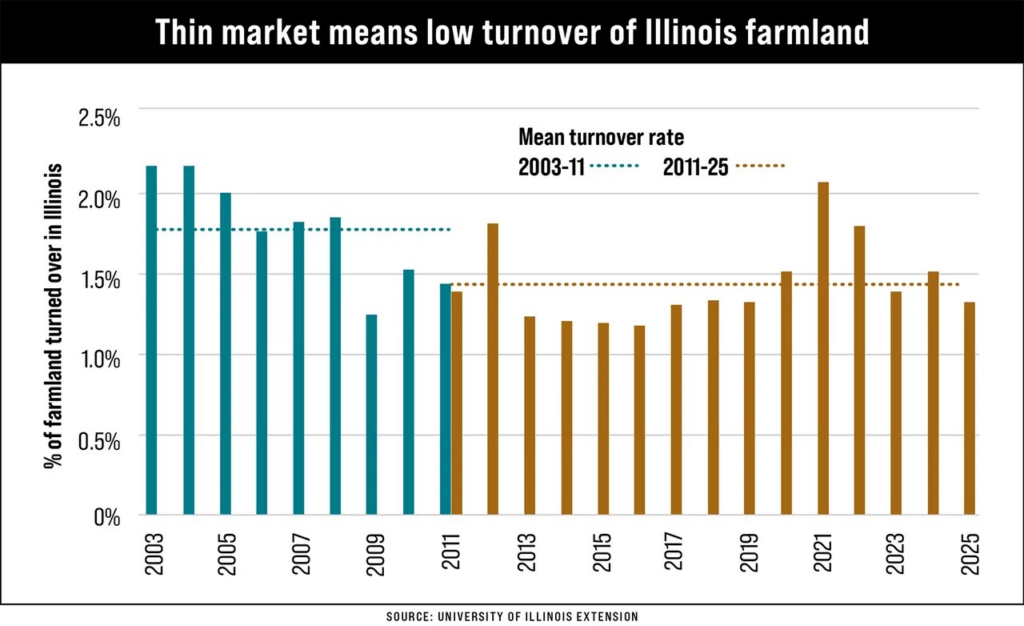
At Land Sales Bulletin, we see these same dynamics across our 10‑state Midwest reporting region: Illinois, Indiana, Iowa, Michigan, Minnesota, Nebraska, North Dakota, Ohio, South Dakota, and Wisconsin. With only 1.5% to 2% of farmland changing hands annually in many states, competition for quality acres remains strong, and farmers continue to make up the majority of buyers.

A steady market doesn’t mean a quiet one—just a competitive one shaped by long‑term value and tight supply: farmprogress.com