Farmland Values Across the Upper Midwest

accountMktgLSB | calendar-monthApril 8, 2026

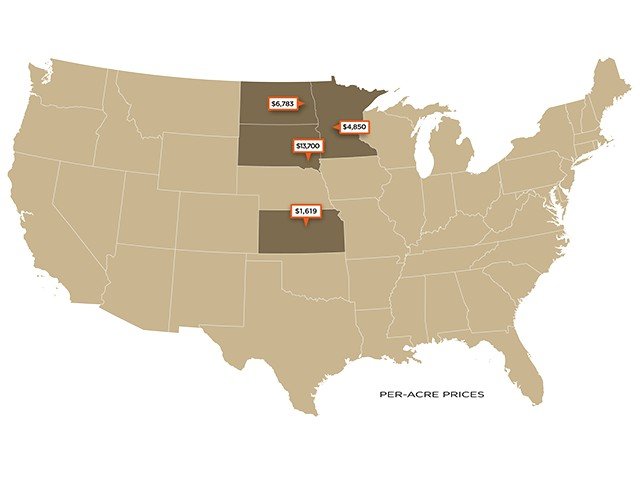
Farmland values across the Upper Midwest continue to be defined by one theme: stability. Despite tighter margins and higher production costs, producers in our Midwest reporting states of Nebraska, Iowa, and South Dakota remain supported by strong balance sheets and historically limited land supply.

The article highlights meaningful differences across the region. Iowa is seeing lower auction volume and modest softening in returns. Nebraska remains steady, with high‑quality tracts still drawing strong interest. South Dakota stands out as the exception, posting increased sales activity and double‑digit gains in pastureland values over the past year.

Local buyers continue to dominate the market, and financing is becoming a more common strategic tool. With supply still constrained and fundamentals holding firm, the Midwest land market remains balanced and resilient — a story where stability itself is the headline. Farm Progress: Here’s the secret to steady farmland values

Celebrating Compeer Financial’s Commitment to the Next Generation of Agriculture

accountMktgLSB | calendar-monthApril 7, 2026

Across the Midwest, few organizations champion rural communities and future ag leaders as consistently as Compeer Financial. Their latest investment—awarding 35 Illinois high school seniors with $2,000 scholarships toward ag‑related degrees—is another powerful example of their long‑standing commitment to strengthening the agricultural pipeline.

These students represent the best of our rural communities: a collective 3.9 GPA, strong involvement in FFA and 4‑H, and a passion for fields ranging from plant and animal sciences to ag business and education. Compeer’s support extends beyond traditional rural areas, with dedicated scholarships for students from metropolitan counties who are pursuing agriculture‑related careers—an important step in expanding ag literacy and opportunity.

Since 2018, Compeer has provided nearly $1.75 million in scholarships to more than 1,000 students, reinforcing their belief that the future of agriculture depends on education, access, and community investment.

We’re proud to support and shine a spotlight on an organization that not only serves today’s producers but also invests deeply in tomorrow’s leaders. Learn more: agrinews-pubs.com

Farmland values across the Midwest remain steady

accountMktgLSB | calendar-monthApril 6, 2026

Farmland values across the Midwest continue to hold steady—even inching upward in places—despite softer commodity prices and persistently high input costs. Recent insights from the Chicago Fed and the Iowa Realtors Land Institute show modest value increases across key crop districts, with tillable acres remaining especially resilient.

Industry experts point to several forces supporting today’s land market: limited supply, strong farmer demand, reinvestment through 1031 exchanges, and ongoing pressure from residential, commercial, and data‑center development. Farmland also remains a favored hedge against inflation, keeping buyers active even in a neutral interest‑rate environment.

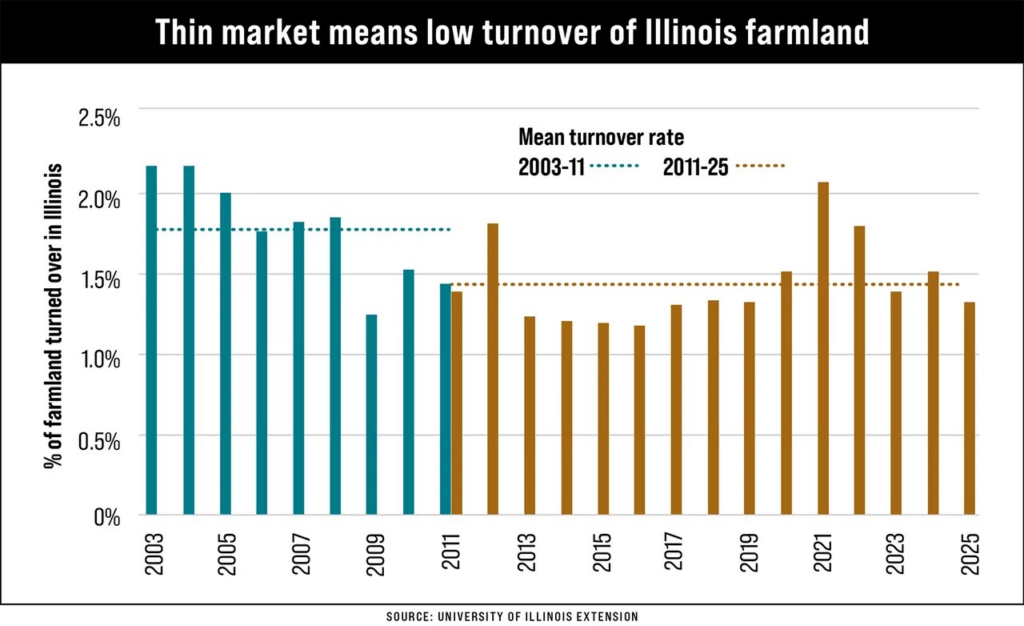
At Land Sales Bulletin, we see these same dynamics across our 10‑state Midwest reporting region: Illinois, Indiana, Iowa, Michigan, Minnesota, Nebraska, North Dakota, Ohio, South Dakota, and Wisconsin. With only 1.5% to 2% of farmland changing hands annually in many states, competition for quality acres remains strong, and farmers continue to make up the majority of buyers.

A steady market doesn’t mean a quiet one—just a competitive one shaped by long‑term value and tight supply: farmprogress.com

A new FinCEN Rule is Poised to Affect More Farm Real Estate Transactions

accountMktgLSB | calendar-monthApril 2, 2026

FinCEN now requires detailed reporting when 1–4 unit residential property is purchased or transferred through an LLC, partnership, or trust. While aimed at urban markets, this rule reaches into agriculture because so many farm operations hold residential structures inside business entities for liability protection and succession planning.

That means common farm scenarios may now trigger reporting, including:

  • Buying a farm with a residence through an LLC
  • Transferring a farmhouse into a family entity
  • Purchasing residential parcels adjacent to farmland
  • Cash or seller‑financed deals involving a dwelling

Even when the primary purpose is agricultural, the presence of a residence brings the rule into play. Closing professionals must report beneficial owners, entity details, payment sources, and property information — adding time and documentation to many transactions.

Why it matters: Farm families who rely on LLCs and trusts for operational and estate planning will see more disclosure requirements and should prepare early to avoid closing delays.

At Land Sales Bulletin, we continue to monitor regulatory changes that influence how land is bought, sold, and transferred across our 10‑state Midwest region. Our mission remains the same: deliver verified, county‑level land sale data and keep our customers informed on the policies shaping today’s land market. Farm Progress: New FinCEN rule could affect farm real estate transactions

Minnesota Farmland Market Holds Steady as 2026 Outlook Improves

accountMktgLSB | calendar-monthApril 1, 2026

Minnesota’s farmland market continues to demonstrate resilience heading into spring, supported by firmer commodity prices, USDA bridge payments, and improved grower sentiment. While demand isn’t at the peak levels seen from 2021–2023, values across the state remain steady, with recent sales showing strong productivity indexes and competitive per‑acre prices

As one of Land Sales Bulletin’s Midwest reporting states, Minnesota plays a key role in illustrating broader regional trends: moderated demand, lower sales volume compared to the boom years, and a market that continues to hold value despite higher interest rates and input cost uncertainty. With farmers entering the 2026 planting season facing more positives than negatives, Minnesota’s land market remains a steady anchor in the Midwest. Read more from Farm Progress: Demand for Minnesota farmland holds steady as outlooks improve

Minnesota land sales - Farm Progress

Nebraska continues to demonstrate why it remains a key state to watch within Land Sales Bulletin’s 10‑state Midwest reporting region

accountMktgLSB | calendar-monthMarch 31, 2026

Southwest Nebraska auction underscored the strength of local demand: a 322.73‑acre irrigated farm in Keith County sold for $10,100 per acre, far above the area’s typical comparables.

According to the broker, the surge was driven not by outside investors but by motivated neighboring farmers. This is a trend that continues to define western Nebraska’s land market. High‑quality soil, reliable irrigation, and the absence of allocation restrictions added to the property’s appeal, but it was the competitive local farming community that ultimately set the pace.

Even as statewide averages soften, Nebraska’s farmer‑driven market remains resilient — a dynamic Land Sales Bulletin tracks closely across its Midwest coverage, including Illinois, Iowa, Indiana, Michigan, Minnesota, North Dakota, Ohio, South Dakota, Wisconsin, and Nebraska. Read More: Farmers Still Driving Nebraska Land Sales, Broker Says

Midwest Notable Farmland Sales March 2026

accountMktgLSB | calendar-monthMarch 30, 2026

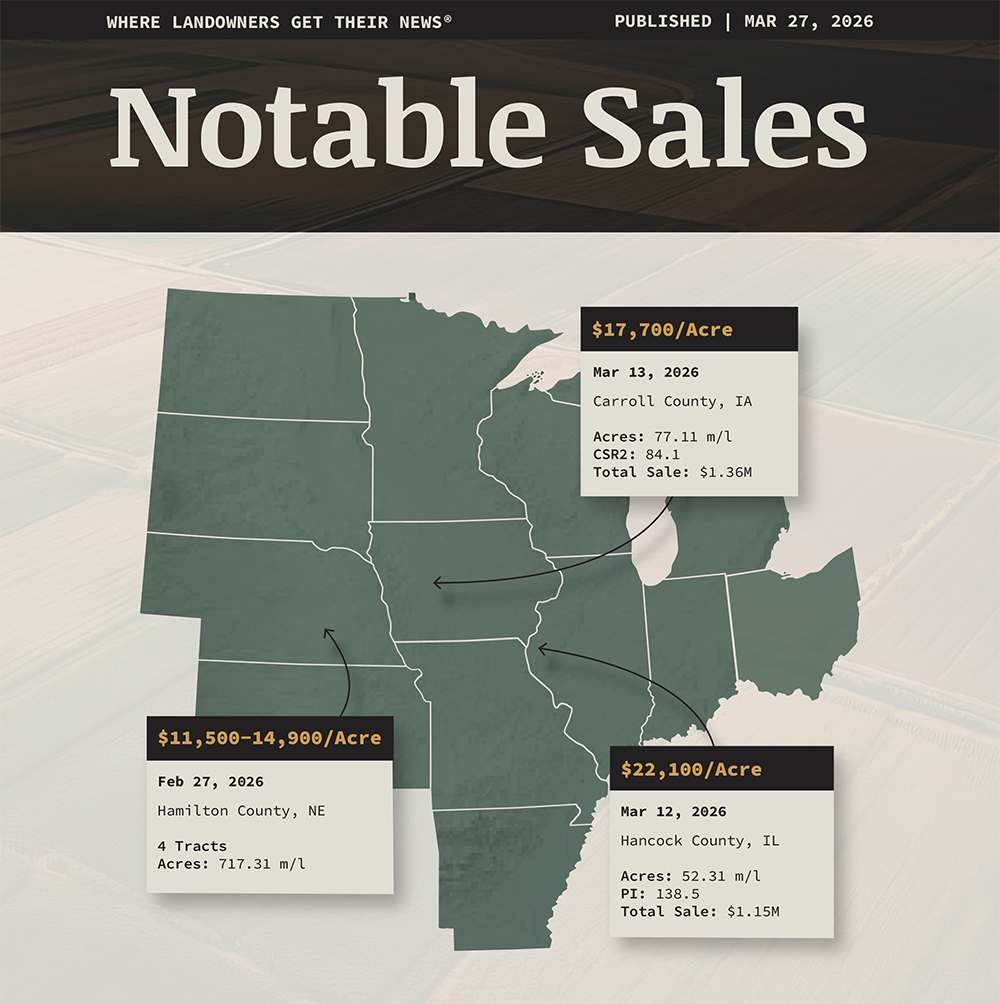
Our Midwest reporting states of Illinois, Iowa, and Nebraska are the featured farmland sales in American Farmland Owner‘s recent Notable Sales report.

Farmland auctions across the 3 featured states show prices from $11,500 to $22,100 per acre, driven by soil quality, productivity, and location. Read details behind each sale https://www.americanfarmlandowner.com/post/midwest-notable-farmland-sales-march-2026

Farmland Values Hold Firm Across the Midwest Despite Weaker Farm Finances

accountMktgLSB | calendar-monthMarch 26, 2026

American Farmland Owner reports on the New Federal Reserve surveys that show farmland values across the Midwest held steady or increased in 2025, reinforcing the strength of the region’s land market even as farm finances weakened.

For those following Land Sales Bulletin’s 10-state Midwest region—Illinois, Indiana, Iowa, Michigan, Minnesota, Nebraska, North Dakota, Ohio, South Dakota, and Wisconsin—the data highlights continued stability:

  • Chicago Fed District: Farmland values up 6% year over year
    • Indiana +9%
    • Wisconsin +9%
    • Iowa +7%
    • Illinois +3%
  • Kansas City Fed District:
    • Non‑irrigated land: –0.3%
    • Irrigated land: +1.2%
    • Ranchland: +4.1%

At the same time, repayment challenges increased, more banks tightened credit standards, and interest rates—while easing—remain above long‑term averages.

Even with these pressures, Midwest farmland continues to stand out as one of the most stable assets in the agricultural economy. Read more: americanfarmlandowner.com

Midwest Farmland Values – “The Selective Strength” Era

accountMktgLSB | calendar-monthMarch 24, 2026

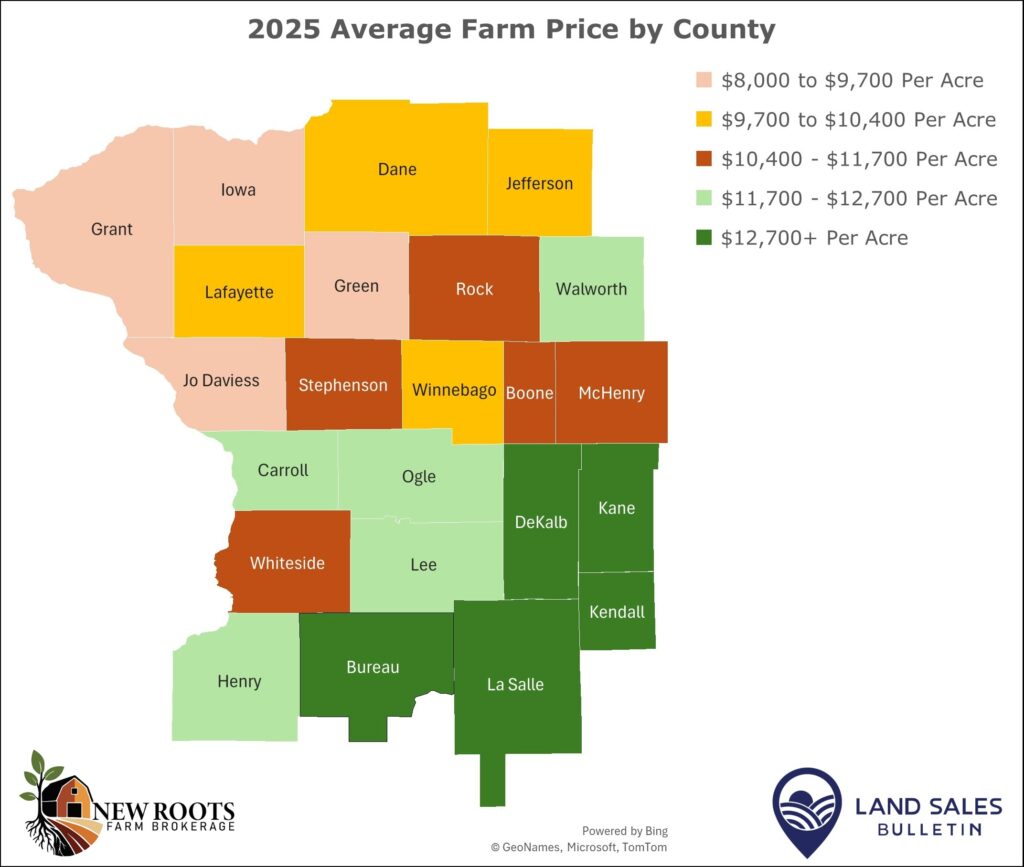
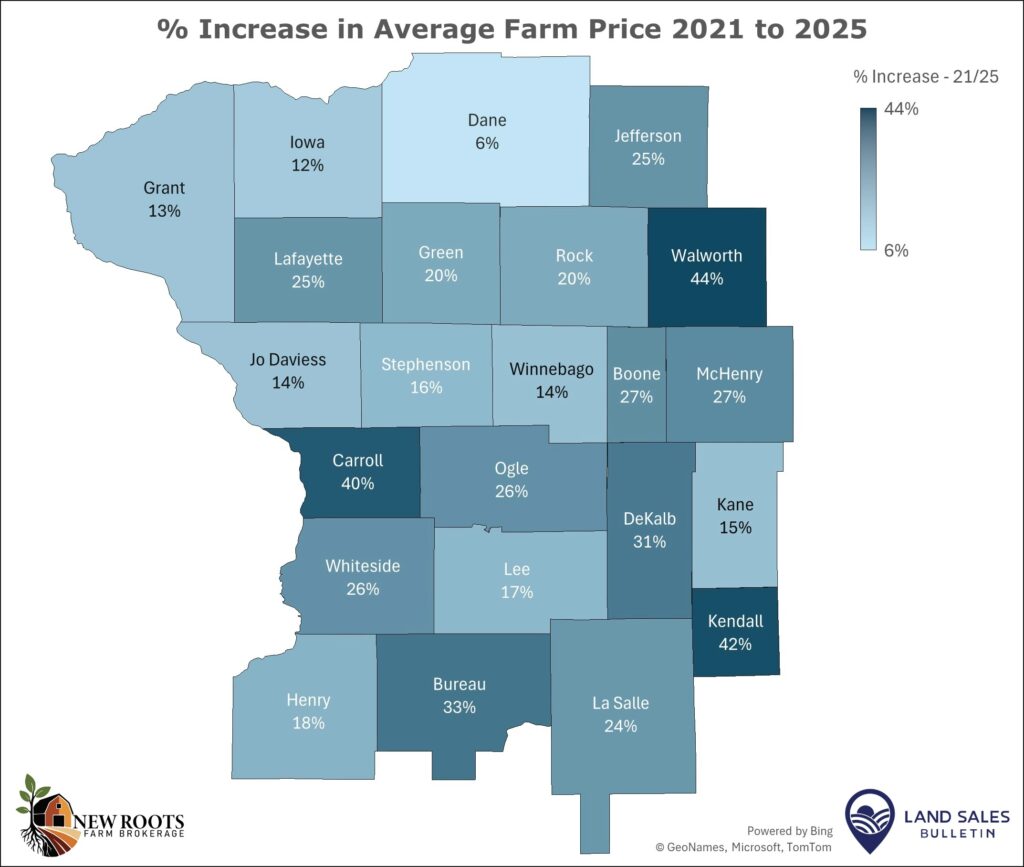
Nick Westgerdes, AFM, owner of New Roots Farm Brokerage, shares specialized farmland value insights and management reports for our Midwest reporting states of Illinois and Wisconsin. As the current President-Elect of the Illinois Society of Professional Farm Managers and Rural Appraisers (ISPFMRA), his recent 2026 reports highlight a “resilient” but evolving market using our Illinois and Wisconsin land sales data. New Roots Farm Brokerage – Client Driven & Farm Focused.