The past year was one of transition and new beginnings for the Research and Demonstration Farms operated by Iowa State University.
At the leadership level, Kendall Lamkey was named director of research farms and associate dean for facilities and operations for the College of Agriculture and Life Sciences in May. Lamkey’s appointment follows the retirement of director Mark Honeyman in 2022.
Lamkey previously served as chair of the ISU Department of Agronomy. He says he looks forward to showcasing the farms and the work being done by ISU specialists.
“The research farms are a huge asset for the university and the College of Agriculture and Life Sciences,” he says. “They’re an avenue for our faculty to execute their research, teaching and Extension programs, and also an avenue for our demonstration projects in Extension.”
Senate Agriculture Committee Chair Debbie Stabenow, D- Mich., sent a memo to committee colleagues Wednesday spelling out five key principles she says will modernize the farm bill safety net. Those principles include targeting programs to active farmers, giving farmers more choice and flexibility, providing assistance in a timely manner, expanding the reach of programs to help more farmers and addressing the risks that emerging farmers face.
Stabenow says crop insurance is a key tool to meaningfully advance each of those goals.
“Whether I’m talking to farmers at a hearing, field day, or local diner, they all emphasize the importance of crop insurance,” she says. “Over time, we have made meaningful improvements, provided more choices for existing coverage, and expanded its reach to cover more crops, varieties, areas, and types of production.”
According to the Senator, crop insurance is working. She notes that while other programs take years to assist farmers after a disaster, crop insurance has provided nearly $30 billion in “timely support” in 2022 and 2023 so far.
Among other proposals, Stabenow wants provide all commodity groups the option of choosing between traditional base programs and a subsidized, streamlined area-based crop insurance policy. The 2018 Farm Bill gave this option to cotton producers.
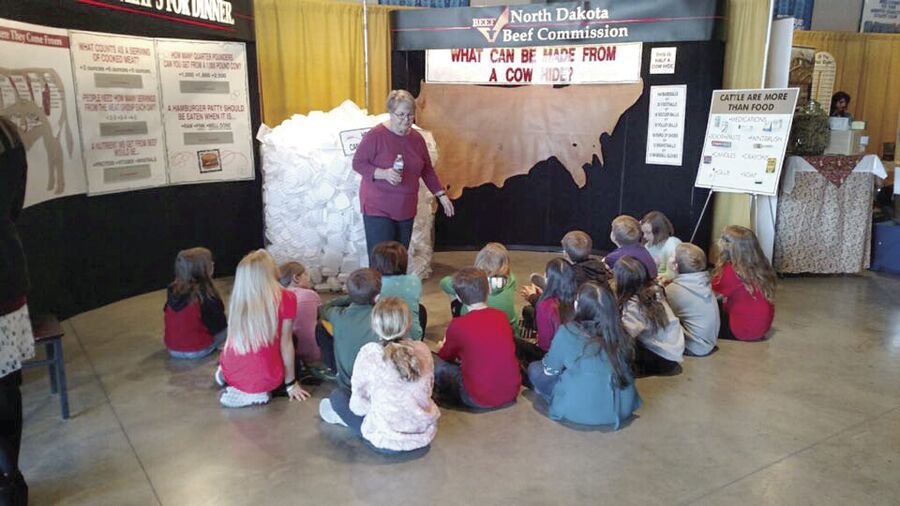
One of the most anticipated and attended features of the KMOT Ag Expo, the Living Ag Classroom, is back for another year of educating area students about production agriculture.
Designed at its roots as a teaching tool for elementary age students without a family background in agriculture, the program attracts fourth grade students from around the region to learn about all the processes involved with production agriculture.
“The Living Ag Classroom is kind of a staple of the KMOT Ag Expo,” said Todd Telin, KMOT Ag Expo manager. “We have 10 different commodity groups here to show the kids all about the agriculture process, like how honey is made and how wheat is turned into bread. It’s really great for the kids.”
Typically, approximately 600-700 students are bused in to participate in the Living Ag Classroom during the KMOT Ag Expo. The students travel in from around a 50-60 mile radius.
Participating students rotate through an assortment of hands-on activities in an effort to help teach them all about North Dakota agriculture and the process that puts food on their plates.
Each activity is sponsored annually by various commodity groups who set up the different activity sections and provide an approximate 15-minute presentation to help teach these students about production agriculture.
Many people feel that the USDA Farm Service Agency and Natural Resources Conservation Service have nothing to do with them. But they have everything to do with assisting local farmers in keeping their farms sustainable for future generations.
“FSA and NRCS work with our local farmers to increase the health and productivity of the soil on their ground by developing conservation plans and implementing these plans,” says Kayleen Hart, FSA program technician for Steuben County, Ind. “Along with our local partner, the Steuben Soil and Water Conservation District, we are able to offer technical and financial assistance to help farmers implement best management practices for their farm.”
Why is this important to everyone? “With the global population increasing, available farm ground continuing to decrease due to development or misuse, and erratic weather patterns due to climate changes affecting crop production, keeping the farm ground we have is important – not only to the farming community, but to everyone who loves to eat,” Hart says.
Ryan Waite and his family, who farm in Steuben County, have applied sustainable farming techniques for about 10 years. “In the last few years, we’ve completely converted all our acres to 100% cover crops and 100% no-till,” Waite says.
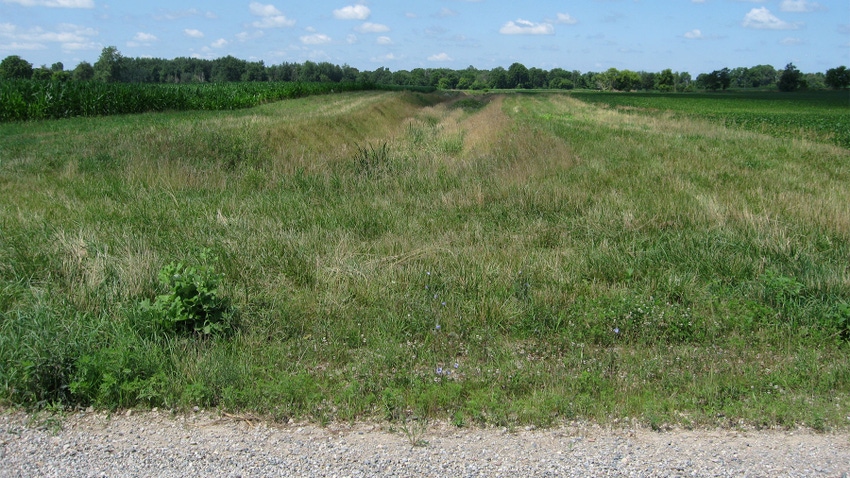
They also use filter strips where needed and are finding new ways each year to enhance their sustainability.
“My advice to the next generation is to keep evolving, keep researching, don’t be afraid to try something,” Waite says. “Everything is always changing.”
These changes have helped the Waite farm manage water quality and retain moisture within the soil where it would typically run off or evaporate.
Ever wish you could freeze time? We each have a moment that is branded in our minds for eternity. If only we could capture that memory and share it with others.
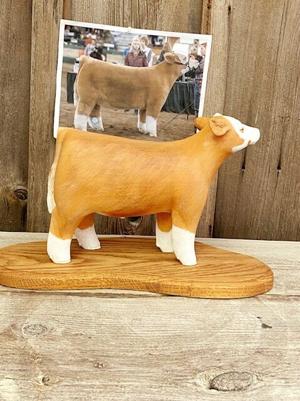
Jared Schlipf is replicating these special memories for people in the livestock industry with hand-carved livestock replicas. A third-generation livestock showman and producer himself, this native of rural Illinois is gaining attention from livestock show families, breeders, ranchers and show sponsors nationwide.
Jared Schlipf Design memorializes a specific animal or a point in time through tangible artwork. The tagline “we’re replicating memories” says it all.
His models are perfect miniatures of the real animal. A Hampshire hog seemingly struts with the white and gray band encircling his black torso, ears erect as if he were commanding the show ring. The muscular definition of a market wether goat is precisely etched, with even the direction of the hair on his legs evident. Every detail of a Hereford steer is intricately carved, from the swirl in his red and white coat to the split in his ear just left of the lime green ear tag.
Realism and perfectionism are trademarks of Schlipf’s work.
“Everything is done by hand, shaping to fit the structure and contour lines of that specific animal,” he said.
Typically measuring 7 inches tall, the replicas begin as a single block of wood. Schlipf follows a photograph of the animal to duplicate the profile onto the block before he begins cutting and carving.
Schlipf has raised, showed and judged multiple animal species. All of his experiences in the livestock industry contribute to his thorough knowledge of breed and structure, allowing him to accurately execute every detail of an animal while carving.
This week USDA officials announced the agency’s Foreign Agricultural Service will award more than $230 million in funding to nearly 70 agricultural organizations. The money will be used to support market expansion efforts. It will be distributed through the Market Access Program and Foreign Market Development Program.
Around $174 million will be distributed by the Market Access Program to 68 nonprofits and cooperatives. Those groups will use the funds for brand and customer promotion initiatives in fiscal year 2024. Cotton Council International will receive the largest allocation at nearly $14.8 million. The U.S. Meat Export Federation and the Food Export Association of the Midwest USDA will receive $12.8 and $10.1 million respectively.
On the other end of the scale, the National Industrial Hemp Council. Synergistic Hawaii Agriculture Council. California Olive Committee, American Feed Industry Association and Mohair Council of America will each receive allocations totaling between $134,000 and $202,000.
Farmers across Minnesota are implementing conservation practices to protect their land and the environment around them for future generations.
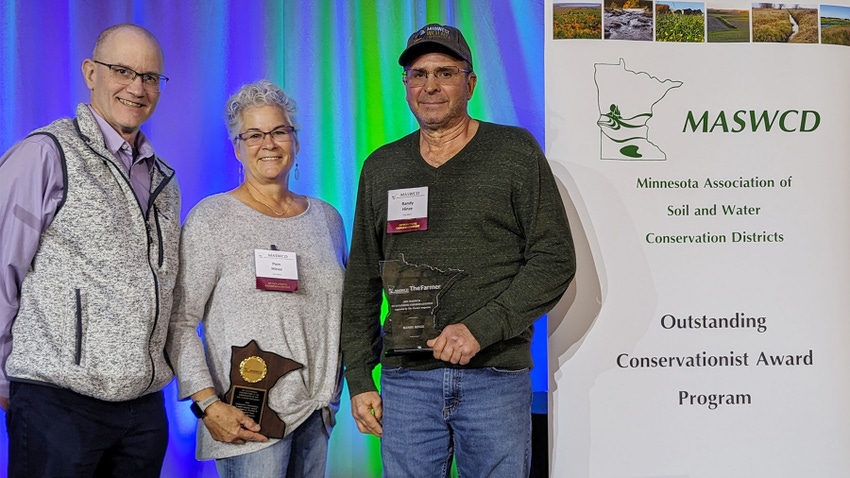
Some of these farmers were recently honored for their efforts by being named finalists for the state’s 2023 Outstanding Conservationist Award. Randy Hinze of Pine City, Minn., is the finalist from Northeast Area 2 and was named as the state’s outstanding conservationist.
The award program recognizes farm families, individuals, conservation organizations and other groups for their accomplishments in implementing conservation practices and improving Minnesota’s natural resources. The program is sponsored by the Minnesota Association of Soil and Water Conservation Districts, with support from The Farmer magazine.
Following are the area finalists who were honored at the 87th MASWCD annual meeting during an awards luncheon Dec. 13 in Bloomington, Minn.
Randy Hinze doesn’t feel as though he is doing anything differently than other farmers, but his efforts earned him the honor of being named 2023 state outstanding conservationist by the Minnesota Association of Soil and Water Conservation Districts.
Hinze was announced as the winner during an awards luncheon at the 87th annual meeting of the MASWCD Dec. 13 in Bloomington. The award program recognizes farm families, individuals, conservation organizations and other groups for their accomplishments in implementing conservation practices and improving Minnesota’s natural resources. The program is sponsored by MASWCD, with support from The Farmer magazine.
“It’s quite an honor,” says Hinze, Pine City, who was nominated by the Pine SWCD. “Everybody works hard at doing a good job out there, but it’s nice to be recognized.” Hinze represented Northeast Area 3 as one of eight finalists.
Each regional finalist was showcased in a presentation during the luncheon, prior to Hinze’s crowning moment. After seeing the competition, Hinze’s wife, Pam, was even more amazed when her husband was announced as the winner.
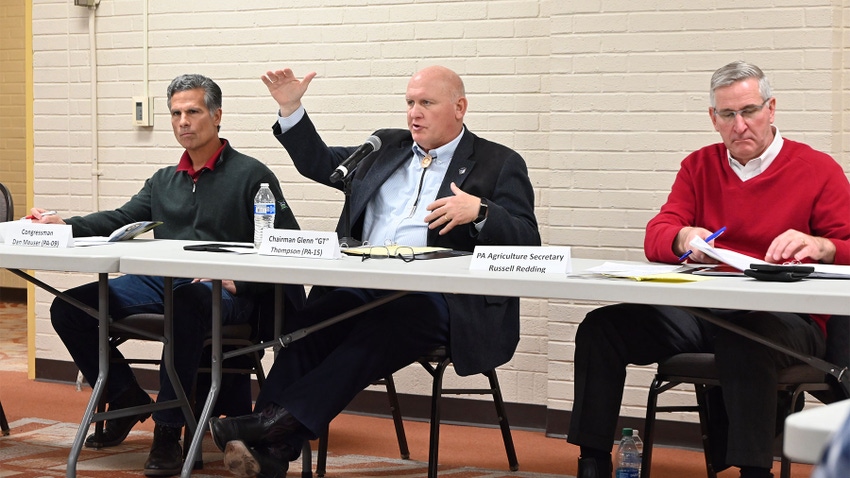
Will the luck of the Irish shine down on Congress in March? Rep. Glenn “GT” Thompson, R-Pa., hopes so, as this is when he plans to finally get a new farm bill on the House floor.
Speaking at the 108th Pennsylvania Farm Show, Thompson said March is the soonest he will be able to get a new farm bill on the floor, as at least three weeks are needed to get it from his desk to the House Agriculture Committee and then to the House floor. Thompson is chairman of the House Ag Committee.
“And so that’s what I proposed to the speaker. He was supportive,” he said after a 90-minute listening session during the opening day of the farm show.
The current farm bill, which was scheduled to run out late last year, was extended to Sept. 30 of this year as part of a budget extension package. One big issue that could be a sticking point for negotiations is money from the Inflation Reduction Act of 2022, almost $20 billion, that was originally set aside for climate-smart ag practices through existing USDA programs such as the Environmental Quality Incentives Program, the Conservation Stewardship Program and others.
The outlook of financial conditions for agriculture is intended to address the challenges and opportunities that likely lie ahead. However, any attempt at clarity for 2024 must begin with a review of the financial environment that prevailed during the past couple of years.
It would be difficult to find any businessperson, agricultural or otherwise, who hasn’t seen their financial situation impacted by the steady increase in interest rates. As of December 2023, the Federal Reserve has raised interest rates 11 times since the beginning of 2022, raising the Federal Funds Rate from essentially zero to 5.5%. This pace of interest rate increases hasn’t been witnessed since the early 1980s. Justification for these monetary policy moves is based largely on attempts to slow red-hot inflation that reared its ugly head in several different forms (demand-pull, cost-push, and wage-price spiral). Each type of inflation naturally emanated from the policy measures used to combat the global pandemic and stabilize a crippled economy.

 Senate Agriculture Committee Chair Debbie Stabenow, D- Mich., sent a memo to committee colleagues Wednesday spelling out five