New analysis from farmdocDaily examines why U.S. farmers own farmland and how they view future land values, drawing on results from the August 2026 Purdue University-CME Group Ag Economy Barometer survey. Responses from approximately 400 producers underscore the unique role farmland plays across the Midwest and beyond.
Report Highlights:
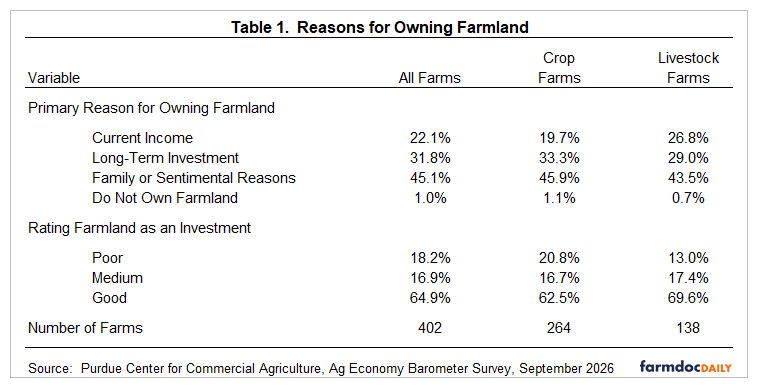
Family or sentimental reasons were the top motivation for owning farmland, cited by 45 percent of respondents
Long-term investment ranked second at 32 percent, followed by current income at 22 percent
Two-thirds of producers indicated farmland is a good investment
Producers were more optimistic about farmland values five years out than over the next 12 months
Alternative investments and interest rates were identified as the most influential factors affecting farmland values
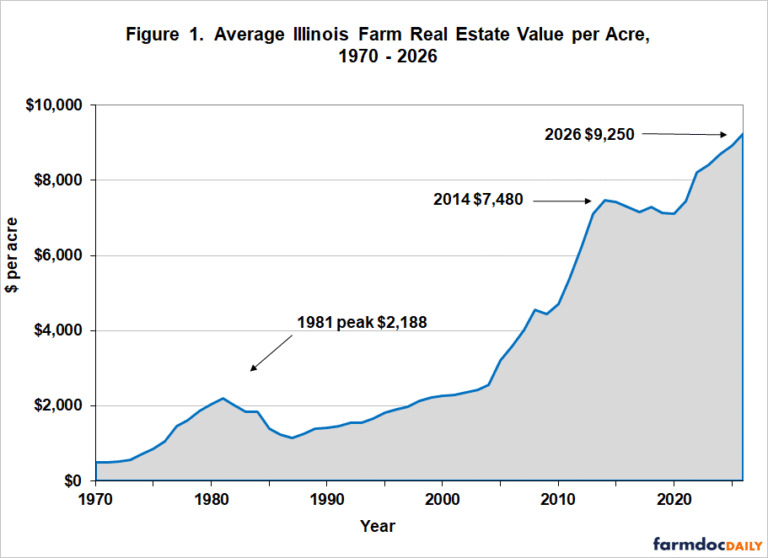
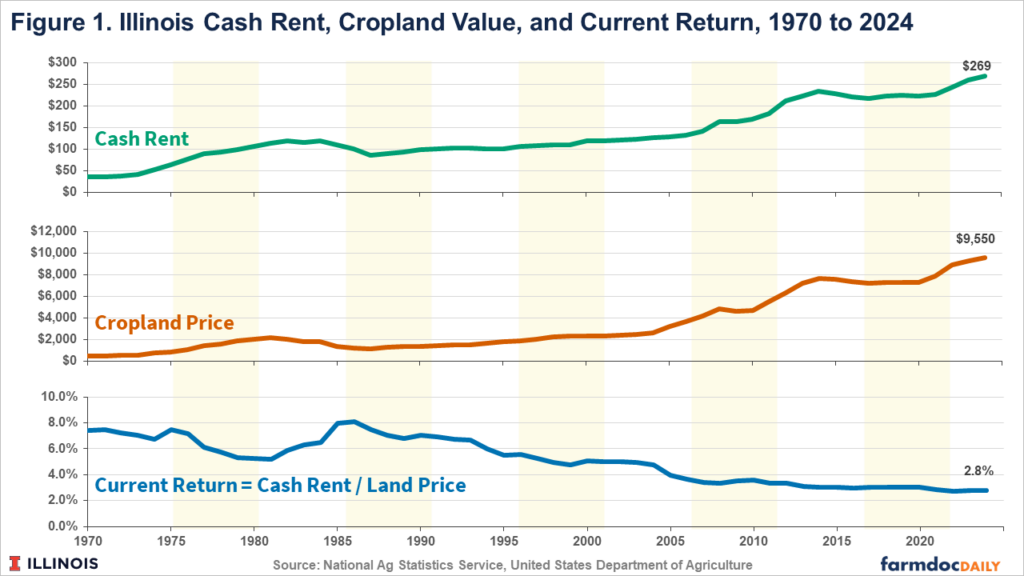
Illinois farm real estate values continued their upward trend in 2026, marking the sixth straight year of gains. According to the latest USDA NASS Land Values Summary, Illinois reached an average of $9,250 per acre in 2026, a 3.6 percent increase over 2025. This steady growth aligns with broader Corn Belt movement, where LSB;s Midwest and neighboring states also posted moderate increases.
Midwest State Highlights
Illinois: $9,250 per acre in 2026, up 3.6 percent from 2025; sixth consecutive annual increase
Iowa: 3.2 percent increase; highest regional value at $10,100 per acre
Indiana: 3.4 percent increase
Missouri: 4.0 percent increase
Ohio: 3.2 percent increase; second highest value at $9,650 per acre
Illinois previously held the top position in 2021, but stronger gains in Iowa and Ohio over the last five years have shifted regional rankings.
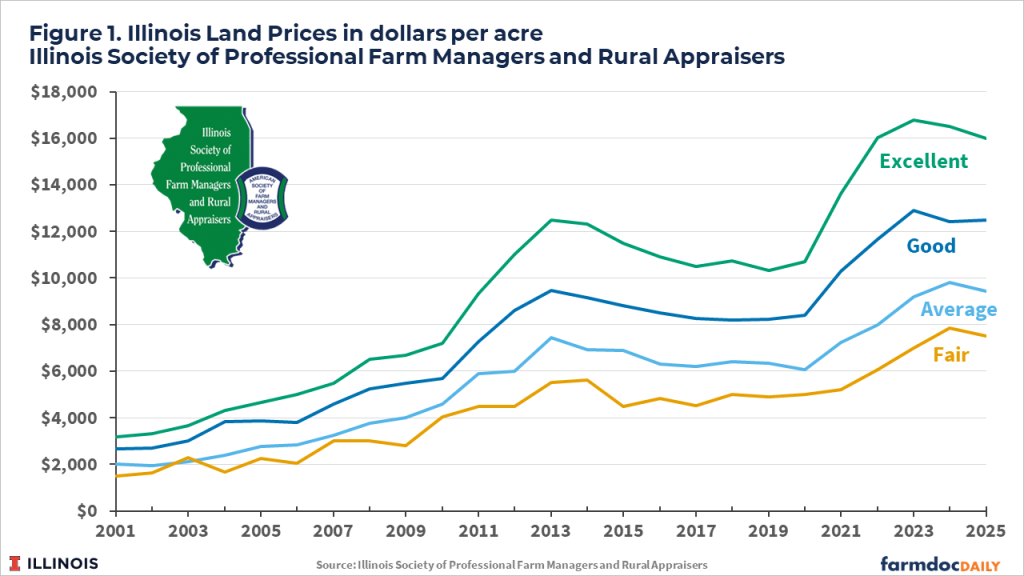
Illinois farmland values rose sharply from 2020 to 2023, then held steady or eased slightly through 2025, even as farmer returns fell and turned negative on many cash‑rented acres. Excellent‑productivity farmland climbed 57 percent during the upswing, then declined only 5 percent from its 2023 peak.
Cash rents followed a similar pattern, rising quickly during strong return years, then barely adjusting downward when returns weakened.
Federal programs, including crop insurance, ARC and PLC, and recent ad hoc assistance, continue to buffer income and slow cost‑structure adjustments across Illinois agriculture.
These dynamics explain why farmland prices have not retreated meaningfully and why rent negotiations remain tight heading into 2026 for our Midwest reporting state of Illinois.
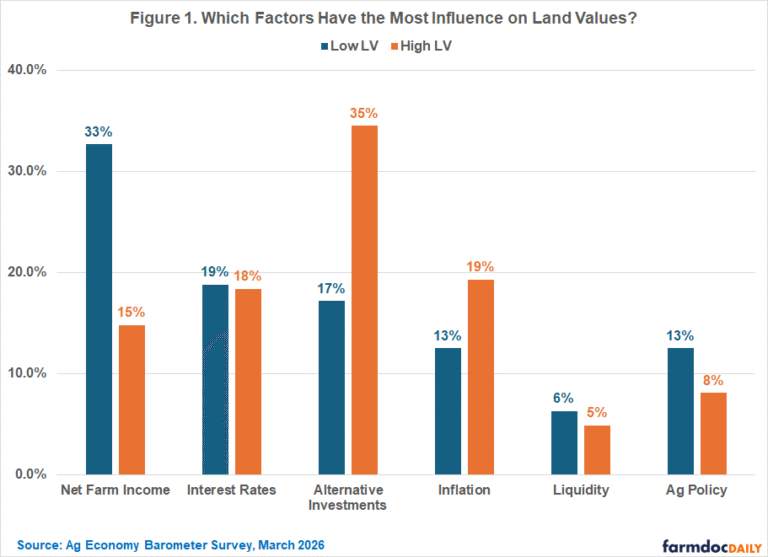
Producer sentiment continues to diverge sharply depending on how farmers view the direction of land values. The March 2026 Purdue University–CME Group Ag Economy Barometer shows that only 10% of producers expect land values to decline, while 35% expect them to rise over the next 12 months . Those expecting higher values also reported stronger current conditions and more optimism about future financial performance—with a Financial Performance Index of 111 compared to 93 among those expecting declines .
High input costs remain the top concern for both groups, though the pressure is felt more intensely among producers anticipating lower land values . And when asked what’s driving land values locally, the groups split: those expecting declines pointed to net farm income, while those expecting increases cited alternative investments as the biggest influence .
Why Land Sales Bulletin’s Midwest Data Is Essential
That’s where Land Sales Bulletin provides critical clarity. By documenting finalized, completed farmland sales across 10 Midwest states, LSB delivers the ground‑truth data needed to interpret sentiment shifts in real time. When producers express optimism or caution, LSB’s county‑level sales reports show whether actual transactions reflect those expectations—or diverge from them.
In a moment when producers are split on the direction of land values, LSB’s consistent sales data helps land professionals, lenders, appraisers, and producers distinguish perception from market reality. It’s the difference between watching the weather forecast and checking the rain gauge.
New survey data from the Illinois Society of Professional Farm Managers and Rural Appraisers (ISPFMRA) points to a steady and resilient leasing environment across Illinois farmland—an important signal for landowners, operators, and investors watching the Midwest market. As one of Land Sales Bulletin’s 10 Midwest reporting states, Illinois continues to demonstrate strong rental demand even as broader price expectations soften.
Cash Rents Hold Firm in 2026 – Survey results show that professionally managed farmland maintained strong cash rent levels for 2026.
Excellent soils: Middle-third rents average $375/acre, with top-tier agreements reaching $400/acre.
Good soils: Average $325/acre.
Average soils: $273/acre.
Fair soils: $200/acre.
Despite slight declines in 2025 landlord incomes—particularly on cash‑rented acres—operators continue to compete aggressively for high‑quality ground, keeping rents elevated across productivity classes.
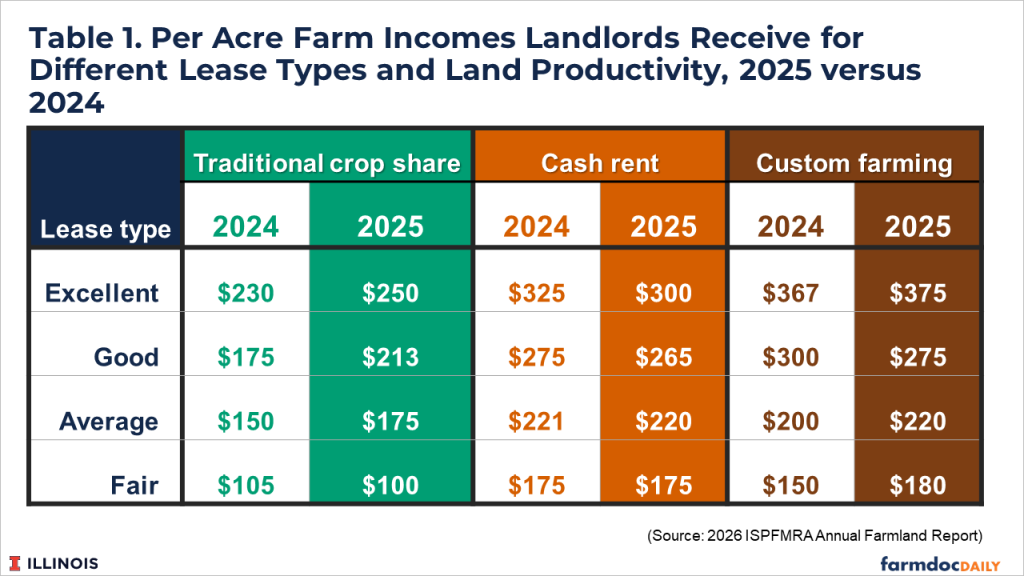
Leasing Performance in 2025 – Returns varied by lease structure:
Custom farming delivered the highest 2025 returns at $375/acre on excellent soils.
Cash rent averaged $300/acre.
Crop share averaged $250/acre, buoyed by strong yields and lower input costs.
These dynamics help explain why cash rents remain strong even as land values show signs of leveling.
Expectations for 2027 – Farm managers express cautious optimism:
67% expect 2027 cash rents to remain unchanged from 2026.
9% anticipate increases.
24% foresee modest softening.
Overall, the data points to a stable leasing market with limited downside pressure.
Why This Matters for Midwest Land Professionals
Illinois—one of our core reporting states—continues to set the tone for leasing trends across the Corn Belt. Strong operator demand, tight supply of high‑quality acres, and steady income expectations reinforce the importance of finalized sales and rental data when evaluating market conditions.
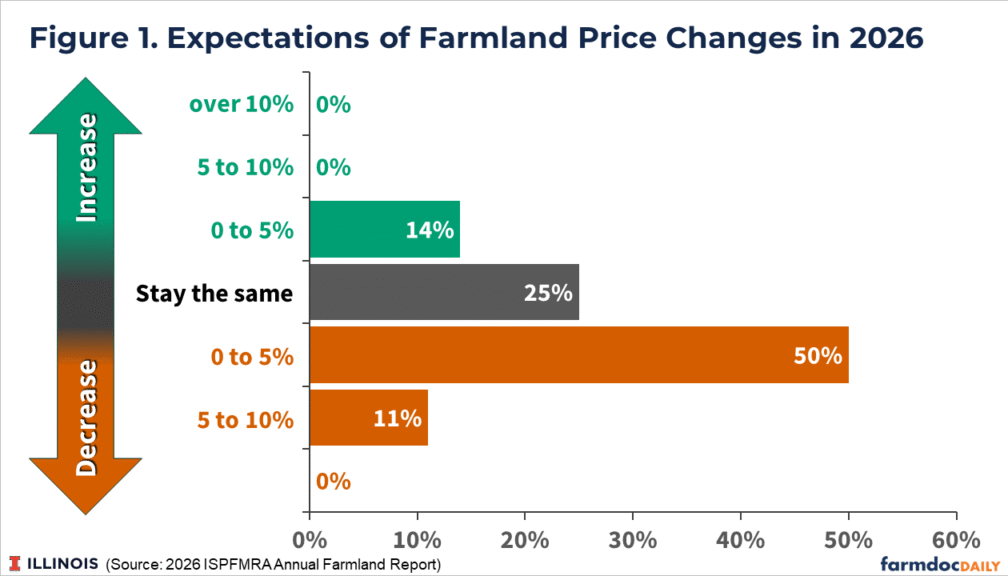
Illinois farmland values are entering a period of stabilization after several years of rapid appreciation. According to the latest ISPFMRA survey, most market participants expect modest softening in 2026, driven by tighter crop margins, elevated input costs, and a high‑interest‑rate environment. While 61% of respondents anticipate slight price declines, long‑term confidence remains strong, with 77% expecting higher values within five years. Transaction volumes are also cooling, and private treaty sales are regaining ground as buyers seek flexibility in a shifting market.
As one of Land Sales Bulletin’s reporting states, Illinois continues to demonstrate the importance of timely, accurate, and completed land sale data in understanding market sentiment and tracking regional trends across the Midwest.
The U.S. ag land price‑rent ratio has nearly doubled since 1998 — rising from 20 to 36 — and no single economic factor fully explains why. New farmdoc analysis shows that if the ratio had held steady, today’s cropland values would be roughly 40% lower. With land making up ~80% of U.S. farm assets, understanding the drivers behind this long‑term shift is essential for lenders, investors, and producers. Read more from Successful Farming – The Dramatic Change in U.S. Ag Land Price-Rent Ratio
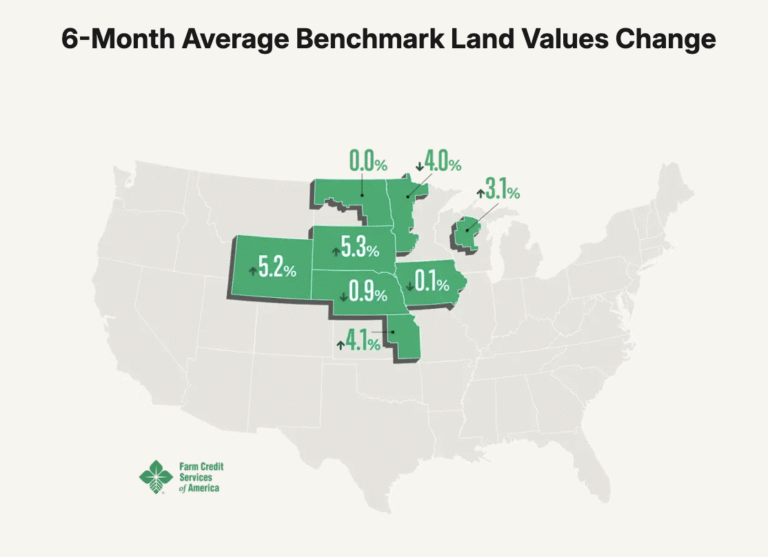
This latest FarmDoc Daily Policy News Summary looks at ag land values through the first 6 months of 2025. Find the 6-Month Average Benchmark Land Values Change for our Midwest states of Wisconsin, Minnesota, North and South Dakota, Iowa, and Nebraska. Key contributors and findings include land value reports from Farmers National Company and Farm Credit Services of America. Read their full report here – Ag Land Values Mostly Stable Through First Half of 2025 – Farm Policy News
The University of Illinois Department of Agricultural and Consumer Economics April 2, 2025 report has been revised. Find details to the May 2 revision in this Successful Farming Report: https://conta.cc/4k558zl
Find farmdoc daily “Outlook for Farmland Values in 2025” for our Midwest reporting state of Illinois. You can read their full report here: https://bit.ly/4g5FDfo
Important Updates to Your Land Sales Bulletin Subscription & Terms of Service
At Land Sales Bulletin, LLC, we are committed to providing you with the most accurate, reliable, and timely finalized land sales data in the Midwest. To better support our platform’s growth and protect the integrity and security of the proprietary data you rely on, we are updating our Terms of Service and Privacy Policy effective January 1, 2027.
What is Changing?
Transition to Automatic Renewal: To ensure you never lose access to critical reporting data during active research, all subscriptions will now seamlessly transition to an automatic renewal system at the end of your billing cycle. You maintain full control and can manage or turn off auto-renewal at any time directly through your account dashboard.
Strict Single-User Policy: To safeguard system security and data integrity, we are reinforcing our account guidelines. Each subscription is legally tied to a single individual user. Sharing login credentials or reporting data with colleagues, coworkers, or external parties is strictly prohibited and monitored by our network systems.
Clarified Data Restrictions: We have updated our language regarding permissible data usage to explicitly bar automated data-scraping software and AI mining tools, ensuring our proprietary database remains secure.
What Do You Need to Do?
No immediate action is required to maintain your access.
If you have any questions about these updates, your single-user account parameters, or your upcoming renewal date, please reach out to our team at sales@landsalesbulletin.com—we are always here to help.