Minnesota Farmland Market Holds Steady as 2026 Outlook Improves

accountMktgLSB | calendar-monthApril 1, 2026

Minnesota’s farmland market continues to demonstrate resilience heading into spring, supported by firmer commodity prices, USDA bridge payments, and improved grower sentiment. While demand isn’t at the peak levels seen from 2021–2023, values across the state remain steady, with recent sales showing strong productivity indexes and competitive per‑acre prices

As one of Land Sales Bulletin’s Midwest reporting states, Minnesota plays a key role in illustrating broader regional trends: moderated demand, lower sales volume compared to the boom years, and a market that continues to hold value despite higher interest rates and input cost uncertainty. With farmers entering the 2026 planting season facing more positives than negatives, Minnesota’s land market remains a steady anchor in the Midwest. Read more from Farm Progress: Demand for Minnesota farmland holds steady as outlooks improve

Minnesota land sales - Farm Progress

Midwest Farmland Market Snapshot

accountMktgLSB | calendar-monthMarch 11, 2026

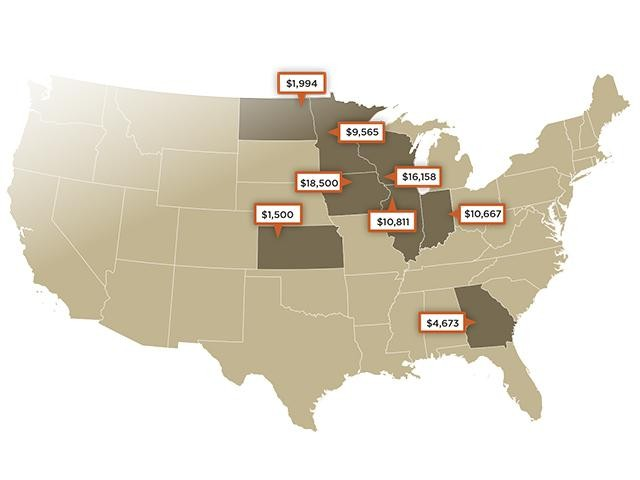
Farmland activity across our Midwest continues to demonstrate strength and resilience, with recent sales underscoring the diversity of land types and buyer demand across Land Sales Bulletin’s core reporting states.

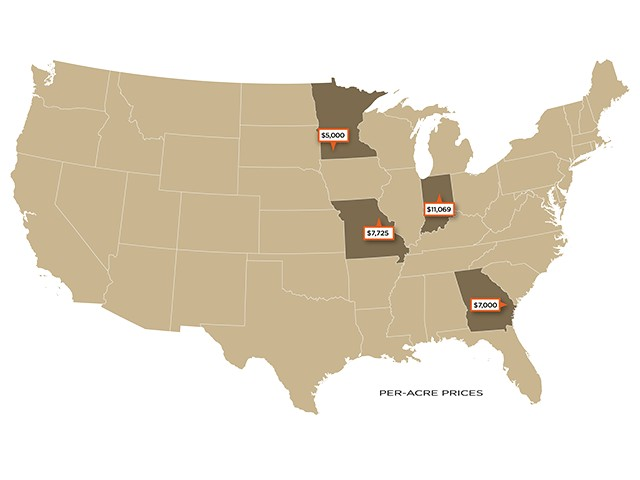
Here’s a concise look at notable transactions featured in the latest Landwatch Weekly:

Indiana – A large 380‑acre Elkhart County farm sold for an average of $20,265/acre, with top tracts of productive tillable ground reaching $24,480/acre. Mixed timber‑tillable tracts followed closely behind.

Minnesota – Rock County cropland brought $17,000/acre across two tracts, supported by strong PLC yields and a productivity index above 96 — a clear indicator of continued appetite for top‑tier soils.

North Dakota – Ramsey County farmland sold for $1,975/acre, with tracts offering 63–68 PI soils and flexibility for spring wheat, peas, corn, soybeans, sunflowers, and canola. Values remain steady in regions where productivity varies but cropping diversity is strong.

Across the region, buyers remain focused on soil quality, crop versatility, and long‑term productivity, even as interest rates and input costs continue to shape bidding behavior.

Land Sales Bulletin provides confirmed, recorded sales across the Midwest — ensuring transparency, accuracy, and a clear view of real market movement. Read more about the highlighted sales from Progressive Farmer: https://conta.cc/4llHfoQ

Minnesota Farmland Market Shows Wide Variability

accountMktgLSB | calendar-monthMarch 10, 2026

Our Midwest state of Minnesota’s farmland market remains a study in contrasts. Some sales are exceeding expectations, while others show signs of softening — and shifting buyer dynamics are playing a major role. Farmers accounted for 70% of Hertz Farm Management’s purchases in 2024, dropping to 58% in 2025 as investor activity increased.

Recent Federal Reserve data shows nonirrigated land values up 0.7% and pastureland up 12% in the 9th District, reflecting strong cattle markets. Strong A‑quality sales continue across Minnesota, with recent prices ranging from $9,779 to $12,916 per acre depending on county and CPI. Read more from Farm Progress: Strength of farmland market continues to vary across Minnesota

As always, Land Sales Bulletin’s timely, finalized land sale data across Minnesota and the broader Midwest provides essential transparency for understanding these trends and benchmarking local market performance: Midwest Land Sales Data

Minnesota land sales - Farm Progress

Are Farmland Values Leveling off Nationwide

accountMktgLSB | calendar-monthFebruary 11, 2026

Farmland values across the Midwest are holding historically strong, even as the market shifts into a more balanced, disciplined phase. According to Farm Progress, our Midwest reporting states from Illinois, Iowa, Minnesota, the Dakotas are seeing values stabilize near record highs, with buyers becoming more selective and quality-driven.
“Midwest farmland values remain historically strong heading into 2026” has been an encouraging and consistent headline. Our data reinforces this message: the market isn’t falling—it’s normalizing, with long‑term confidence and limited supply keeping values elevated. Read more from Farm Progress – Farmland values hold steady, reflect shift toward balanced market

Minnesota Farmland Values in 2025

accountMktgLSB | calendar-monthDecember 30, 2025

The excellence and value we’ve come to know from Whitaker Marketing Group Auctions and Real Estate for reporting our Iowa’s farmland values now extends to Minnesota, bringing the same level of distinction with their expansion into our Midwest reporting state.
Minnesota Farmland Values in 2025: Steady Growth Amid Lower Sales Volume –
In 2025, Minnesota’s farmland values held firm, recording a 1.06% increase to just over $8,054 per acre. Despite this steady growth, the market saw fewer acres offered for sale, resulting in a significant decrease in overall sales volume by nearly 26%. This shift reflects a quieter market, not a weaker one. Find their full comprehensive analysis: Minnesota Farmland Prices: 2024 vs 2025 Market Update

Land Sales: Premium Minnesota farmland continues commanding top dollar

accountMktgLSB | calendar-monthDecember 3, 2025

Premium farmland in our Midwest reporting state of Minnesota continues to defy low commodity price pressure, according to this recent Farm Progress report. “Buyer demand for A-grade, quality land has shown incredible resilience. In the past month, there have been numerous sales in the $12,000 to $15,000-plus-per-tillable-acre price range for choice tracts.” Read more: Minnesota farmland values still strong for quality land

Minnesota land sales - Farm Progress

Farm incomes across the Ninth District continue to fall

accountMktgLSB | calendar-monthSeptember 26, 2025

Farm incomes have been falling throughout the Minneapolis Fed’s Ninth District, which consists of our Midwest states of Minnesota, North Dakota, South Dakota, Wisconsin, as well as Montana. American Farmland Owner comparing the most recent report with one from a year ago, spots trends that have unfortunately come to fruition for farmers in the region. Learn more – Then vs. Now: What Federal Reserve Bank of Minneapolis Reports Tell Us about Farm Future