Factors Influencing Farmland Prices

accountJennifer Moran | calendar-monthSeptember 20, 2023

From Successful Farming: 

Headlines boasting record-breaking farmland sales and surging values gave voice to the excitement in the market last year while land prices climbed. As 2023 marches on, the experts say some of that excitement may be waning and to expect strong, but flatter prices going forward.

                                                       PHOTO: KATIV, GETTY IMAGES

“We’ll probably see some high reports of really high-quality farms that are well-located…and we might see some lower-quality farms start to back up a little bit in prices as we head toward the end of the year,” says Tim Koch, executive vice president of business development for Farm Credit Services of America. “But as a whole, I would anticipate that we’ll see a flattening of prices throughout the remainder of the year.”

Jackson Takach, chief economist at Farmer Mac, put it this way: “You’re still seeing positive gains in land values, quarter over quarter, but at a much-reduced rate compared to ’21 or ’22, when they were in the double digits of annual and quarterly growth. Today they’re in the 1% to 3% range.”
Why Big Finance is Betting on Farmland

accountJennifer Moran | calendar-monthSeptember 18, 2023

From farmprogress.com: 

                                            Photo: Holly Spangler

On the wind-swept plains of the heartland, an agricultural revolution is quietly underway. This one’s not led by advances in machinery or biotech, but rather by the inconspicuous behemoths of financial institutions: the institutional investor.

Who are these institutional investors?

Everyday individual investors make up the entities buying farmland, bringing together funds from people of various professions and backgrounds. Individual investors are people just like you and me: teachers, health-care workers, civil servants contributing to pension funds, or affluent individuals or families engaged with mutual funds or private equity funds. They can also be linked to religious, academic or cultural organizations with sizable endowments.

The attraction of institutional investment vehicles lies in their ability to unlock opportunities that would otherwise be unreachable for individuals.

Institutional investors leverage professional expertise, including financial advisers and fund managers, to make informed investment decisions. They employ a systematic approach to investing, involving rigorous analysis, complex strategies and risk management practices. They garner the benefits of scale, driving down costs, granting access to opportunities not available for smaller investors and potentially boosting returns for those who invest.

2023 WRA Convention

accountJennifer Moran | calendar-monthSeptember 15, 2023

Are you planning to attend this year’s Wisconsin REALTORS Association Annual Convention? If so, we’ll see you there!

We’ll be parked in booth #214 with CamoAg. The perfect opportunity to see the comp tool redefining land sales & analysis. Get ready to rev past the competition!

The Wisconsin Realtors Association Annual Convention | October 1-3, Kalahari Resort, Wisconsin Dells

Information for Setting 2024 Cash Rents

accountJennifer Moran | calendar-monthSeptember 14, 2023

From farmdoc daily: The National Agricultural Statistics Service (NASS) recently released state and county rents for 2023. The Illinois Society of Professional Farm Managers and Rural Appraisers released their projections of 2024 rents on professionally managed farmland. Overall, cash rents increased from 2022 to 2023. Results from the Illinois Society survey suggest that cash rents may decline slightly from 2023 to 2024.

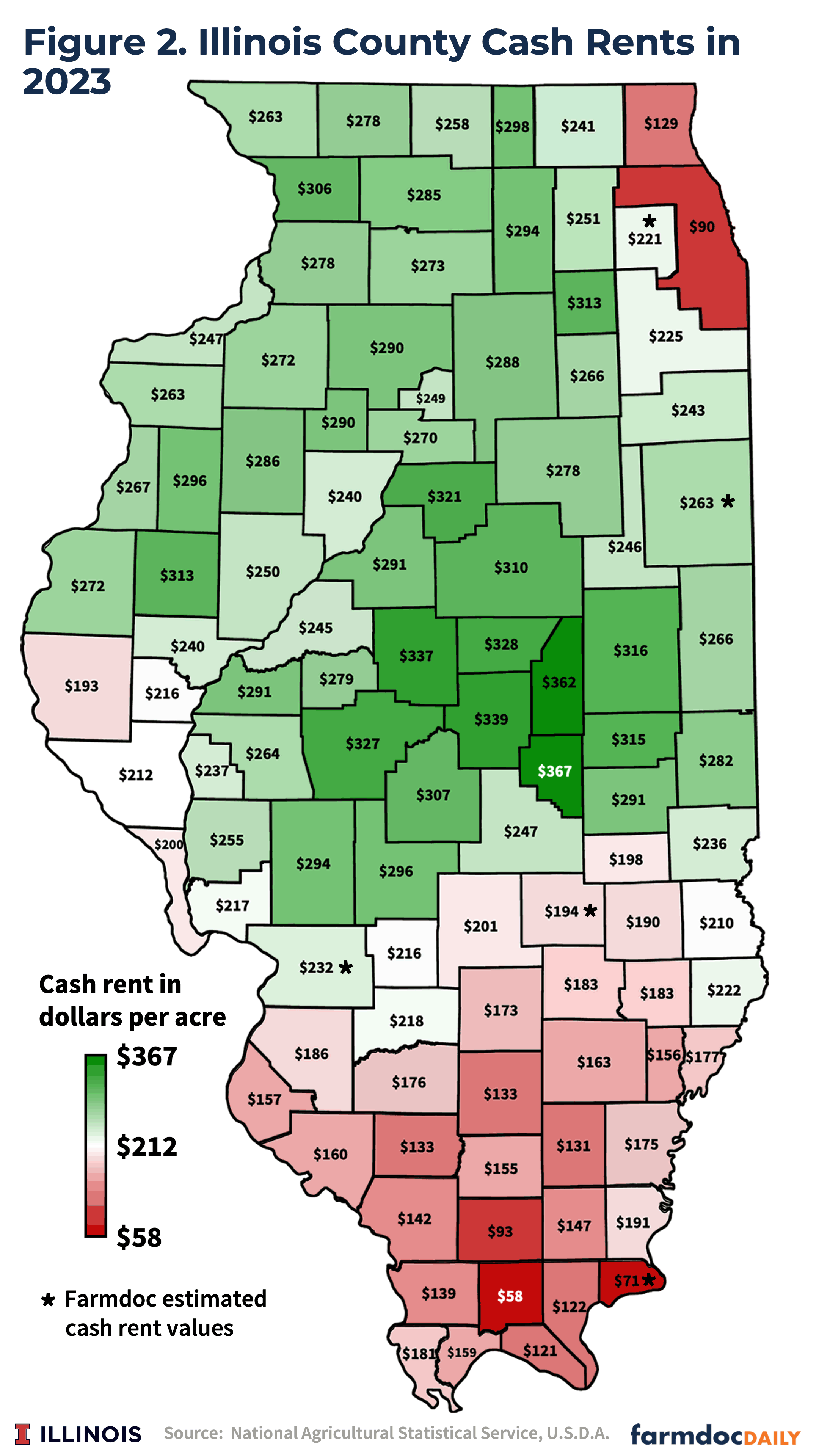
Cash rents vary across Illinois, as illustrated in Figure 2, which shows average county cash rents for non-irrigated cropland released by NASS on August 27. This year, NASS did not report cash rents for some major agricultural counties in Illinois. In Figure 2, rents for unreported counties were estimated based on a regression analysis, discussed below, relating rent levels to a county-level soil productivity index with agricultural district adjustment factors.

As is typical, cash rents are the highest in the central part of the state while cash rents are lower in southern Illinois. The highest reported average cash rent for 2023 is $367 per acre for Moultrie County. The second highest average rent is $362 for Piatt County. Moultrie and Piatt are adjacent counties in central Illinois and tied for the highest cash rent levels in Illinois in 2022 ($331 per acre).  The lowest cash rent reported for 2023 is $58 per acre in Johnson County, a county in southern Illinois which also had the lowest rent reported for 2022 ($53 per acre). See farmdoc daily from September 13, 2022 for last year’s average cash rent analysis.

Land Values Report Shows Stability After ‘Breakneck-Paced’ Growth

accountJennifer Moran | calendar-monthSeptember 12, 2023

From agupdate.com: 

Compared to the last two years, the mid-year land values report, given by Luke Worrell chair of Land Values Conference, at the Farm Progress Show in Decatur on Aug. 30, was anti-climactic.

The snapshot of land values, sponsored by the Illinois Society of Professional Farm Managers and Rural Appraisers, shows stable land values in what he calls a “catch-your-breath” report after two years of a break-neck pace.

“It’s the first time in a long time I don’t have any crazy numbers to throw out,” Worrell said after land values increased between 40% and 50% in some cases during the last couple of volatile years.

“You can’t have 20% increases every year,” said University of Illinois ag economist Gary Schnitkey.

The report comes from a survey of Illinois Society members about what they saw in the first six months of the year and what they expect for the next six months. Not much has changed since the beginning of 2023, Worrell said.

Inflation and Recession Pressures: Is Farmland a Good Investment Right Now?

accountJennifer Moran | calendar-monthSeptember 8, 2023

According to Bruce Sherrick, professor at the University of Illinois, you might not need to worry about what inflation is doing to your farmland values.

From AgWeb.com:  

The Federal Reserve is hosting its Economy Policy Symposium this week, which has all eyes on Jackson Hole Wyoming for further details on inflation, interest rates and if a recession is looming. But would a recession effect your operation the way you think? 

According to Bruce Sherrick, professor at the University of Illinois, you might not need to worry about what inflation is doing to your farmland values.

“Farmland returns are very highly correlated with inflation,” Sherrick says. “Most importantly, it has a positive correlation with inflation.”

Sherrick says this correlation is derived from the size and debt of the industry.

“Put the entire holdings of the country on one balance sheet and it’s now four trillion plus and only 13% leveraged, so 13% debt underneath it,” he says. “An interest rate change doesn’t have as big of a proportional impact as if you were talking about companies traded on the stock exchange, where the average leverage turns out to be around two-thirds.”

While the percentage of debt is low in comparison, he also highlights it’s mostly long-term, fixed-rate debt. Increasing interest rates won’t have as large of an impact on that, but it will decrease transactions.

Kansas City Fed: Farmland Values Remain Strong, as Interest Rates Climb and Farm Income Tempers

accountJennifer Moran | calendar-monthSeptember 6, 2023

From Farm Policy News: In a recent update from the Federal Reserve Bank of Kansas City (“Farmland Values Stay Resilient as Farm Economy Moderates“), Francisco Scott and Ty Kreitman indicated that, “Strength in farm real estate values persisted in the second quarter despite some moderation in the farm economy and higher interest rates.

“Growth in farmland values eased from the surge of recent years, but remained strong through the first half of 2022.

Scott and Kreitman noted that, “Farm income moderated in all the participating Districts during the second quarter. Following nearly two years of considerable strength, improvement in farm income waned according to Federal Reserve Surveys of Agricultural Credit Conditions.”

Wisconsin Ag News – County Cash Rent

accountJennifer Moran | calendar-monthAugust 30, 2023

From USDA: Non-irrigated cropland cash rent averaged $151.00 per acre in Wisconsin during 2023, $6.00 higher than 2022 according to the latest report released by USDA’s National Agricultural Statistics Service. Pasture rented for cash averaged $37.50 per acre, $1.50 above 2022.

Lafayette County had the highest published cash rent for non-irrigated cropland at $259.00 per acre, followed by Grant County at $241.00 per acre. Dane, Brown, and Walworth rounded out the top five. Douglas County, at $20.00 per acre, had the lowest average cash rent for non-irrigated cropland.

Rock County had the highest published pasture cash rent at $76.50 per acre, followed by Lafayette at $69.50 per acre. Forest and Price Counties had the lowest pasture cash rent at $11.00 per acre.

AgLetter: August 2023

accountJennifer Moran | calendar-monthAugust 28, 2023

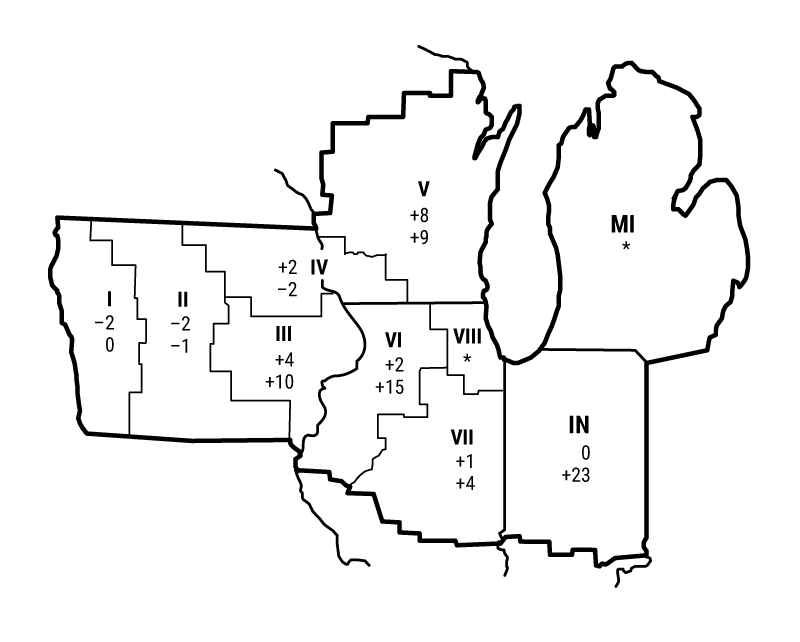
From chicagofed.org: Farmland values for the Seventh Federal Reserve District rose 9 percent in the second quarter of 2023 from a year earlier. This year-over-year gain was the smallest one since the first quarter of 2021. Values for “good” agricultural land were up 3 percent in the second quarter of 2023 from the first quarter, according to survey responses from 153 District agricultural bankers. Nine percent of survey respondents forecasted higher District farmland values during the third quarter of 2023, while 5 percent forecasted lower values; the remaining 86 percent forecasted farmland values to be stable during the July through September period of this year.

Overall agricultural credit conditions for the District were better in the second quarter of 2023 than a year ago, even though farm interest rates were higher. Average nominal interest rates on farm operating, feeder cattle, and farm real estate loans moved up during the second quarter of 2023, ending at their respective highest points since the third quarter of 2007. With repayment rates for non-real-estate farm loans higher than a year ago, the portion of the District’s agricultural loan portfolio reported as having “major” or “severe” repayment problems (1.3 percent) was at its lowest level on record for a second quarter. Also, renewals and extensions of non-real-estate farm loans in the District were down from a year earlier. For the April through June period of 2023, the demand for non-real-estate farm loans was lower than a year ago, as was the level of funds available for lending by agricultural banks. For the second quarter of 2023, the District’s average loan-to-deposit ratio rose to 72.8 percent—the highest reading since the fourth quarter of 2020.

Percent change in dollar value of “good” farmland

 April 1, 2023
to
July 1, 2023
July 1, 2022
to
July 1, 2023
Illinois+2+9
Indiana0+23
Iowa+1+2
Michigan**
Wisconsin+6+8
Seventh District+3+9

The map shows quarterly and year-over-year percent changes in farmland values for geographical areas within the Seventh Federal Reserve District. There were insufficient amounts of survey responses from certain geographical areas, so changes in farmland values are unavailable for these areas.

Top: April 1, 2023 to July 1, 2023

Bottom: July 1, 2022 to July 1, 2023

High-Quality Farmland Is Inching Up In Price Across 18 States

accountJennifer Moran | calendar-monthAugust 25, 2023

Farmers National Company is one of our valued customers and providing value to all our customers is one of our highest goals.  Make sure to check out their mid-year land values report released Tuesday, July 11, 2023.  Their report details and charts how the land market entered a period of de-escalation that started in the fourth quarter of 2022, as well as the current single digit increases in land values verses the double digits over last year.

From AgWeb.com : 

The No. 1 question farmers are asking Paul Schadegg today is whether land values have finally hit a plateau after their long, multi-year run of growth.

That depends, he says, on the region where the farmer is located. In general, he sees a slowdown in price increases across the country but no lower prices for high-quality farmland. 

“When we compare not just our company data but also data from the Federal Reserve surveys, we’re definitely seeing some settling, a de-escalation,” says Schadegg, Farmers National Company (FNC) senior vice president of real estate operations. 


Along with that, he says there are fewer high-quality parcels of land coming to the marketplace.


           June High Quality Values Per Acre

    Average Land Prices


2021

2022

2023

Ark.

$5,600

$6,000

$6,300

Ill.

$12,300

$15,000

$16,000

Ind.

$9,800

$12,000

$13,000

Iowa

$11,900

$15,000

$15,400

Kan.

$4,400

$5,100

$5,800

Ky.

$5,000

$6,200

$7,000

Mich.

$6,500

$7,600

$8,500

Minn.

$7,800

$9,700

$10,000

Mo.

$6,400

$7,200

$7,500

Neb.

$8,800

$11,500

$12,000

N.D.

$6,400

$8,200

$8,800

Ohio

$8,150

$9,800

$11,000

Okla.

$2,500

$2,900

$3,300

S.D.

$8,700

$11,000

$12,100

Tenn.

$4,000

$4,800

$5,200

Texas

$3,700

$4,200

$4,800

Wis.

$7,000

$7,900

$8,500


Source: Farmers National Company Agent Survey